





 Battery: 78 kWh
 Company car tax (2026/27): 4%
 Range: 300 miles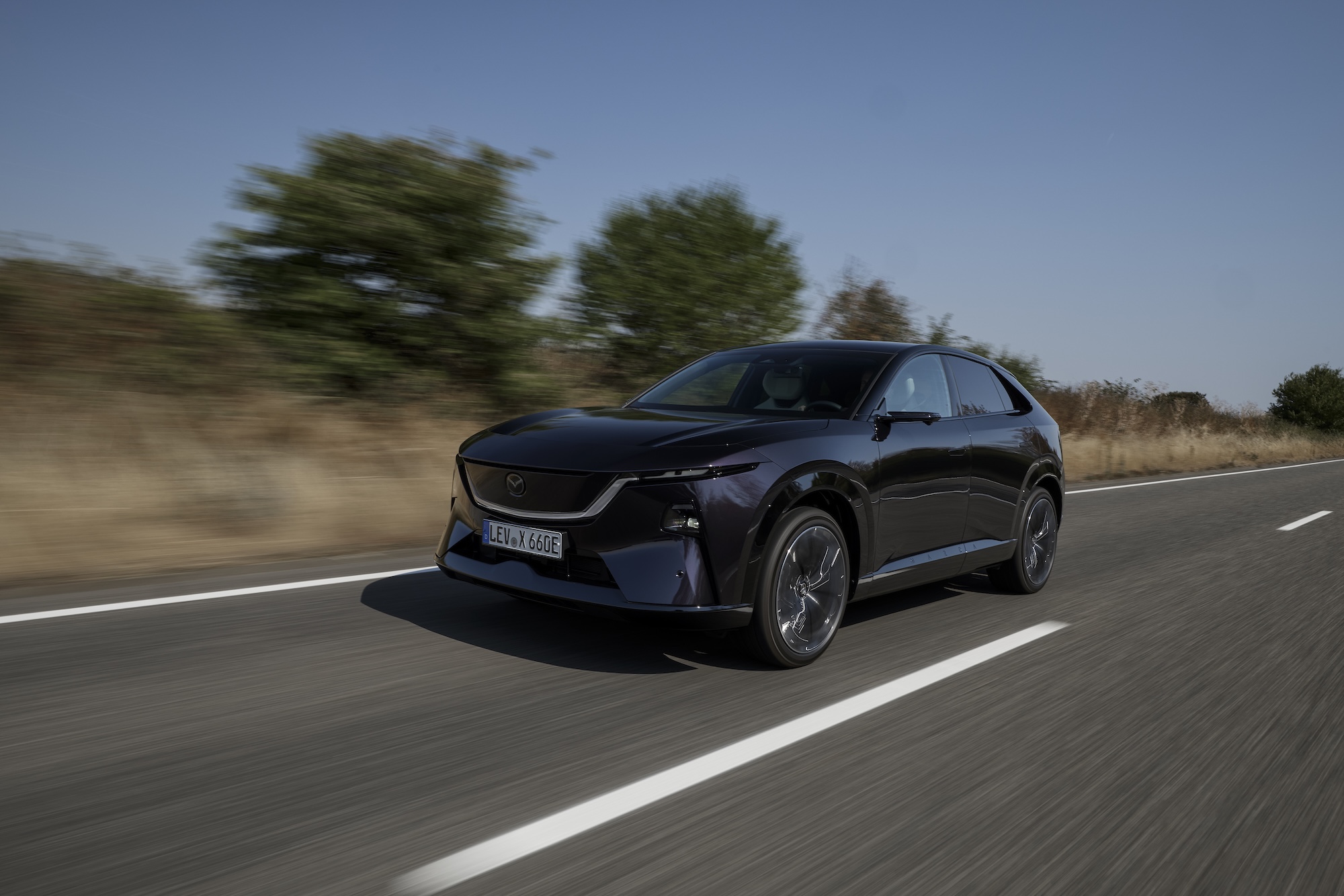
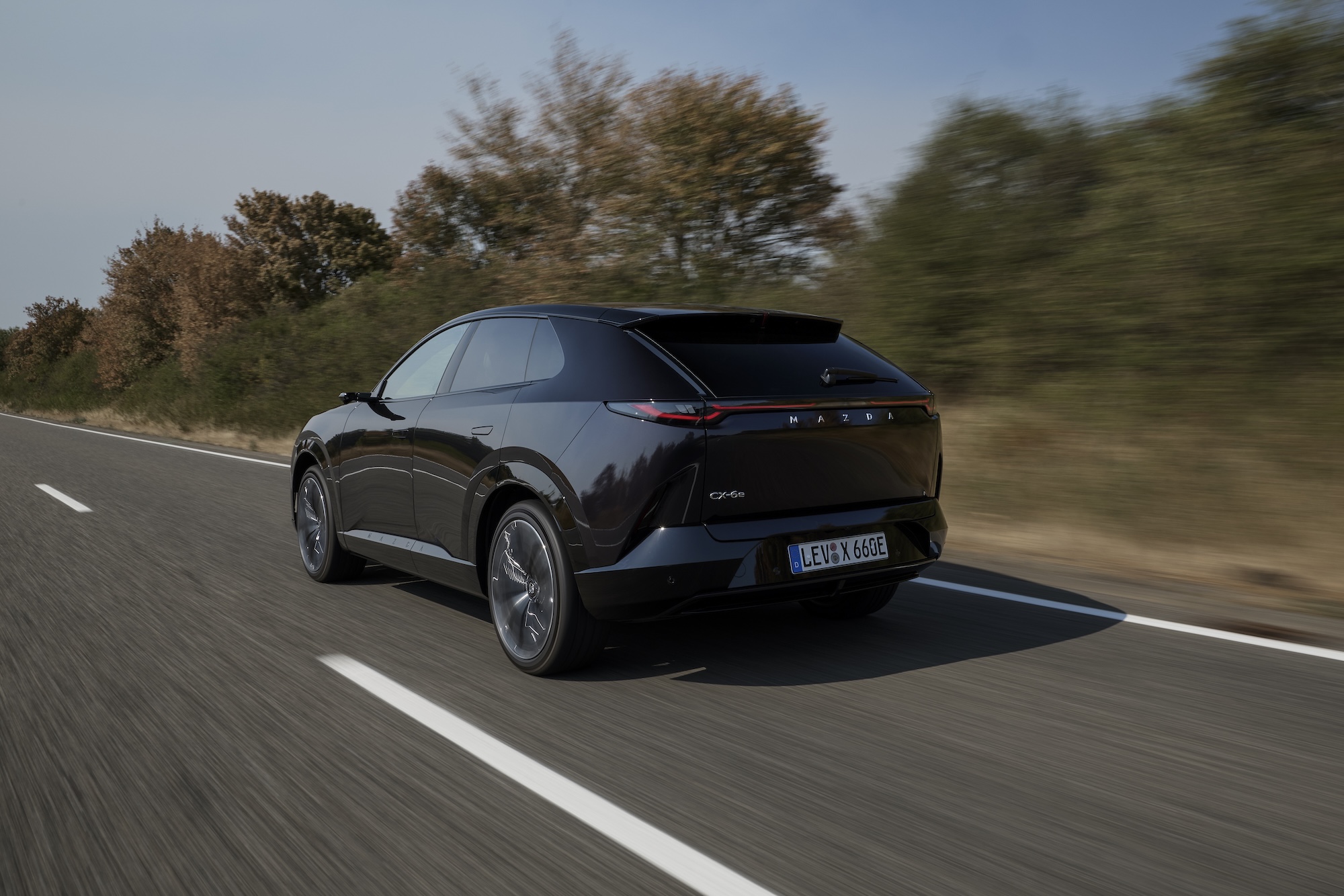
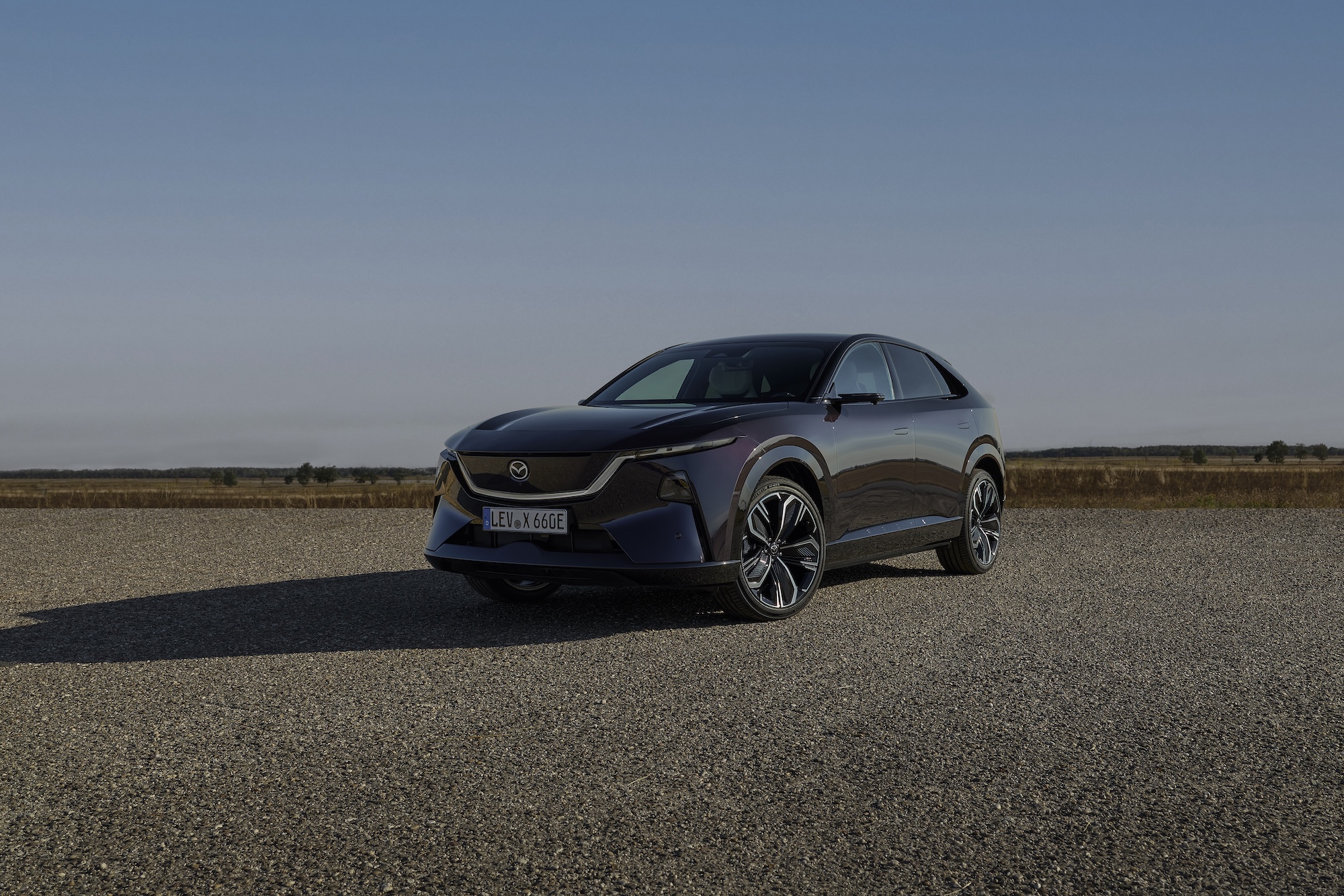
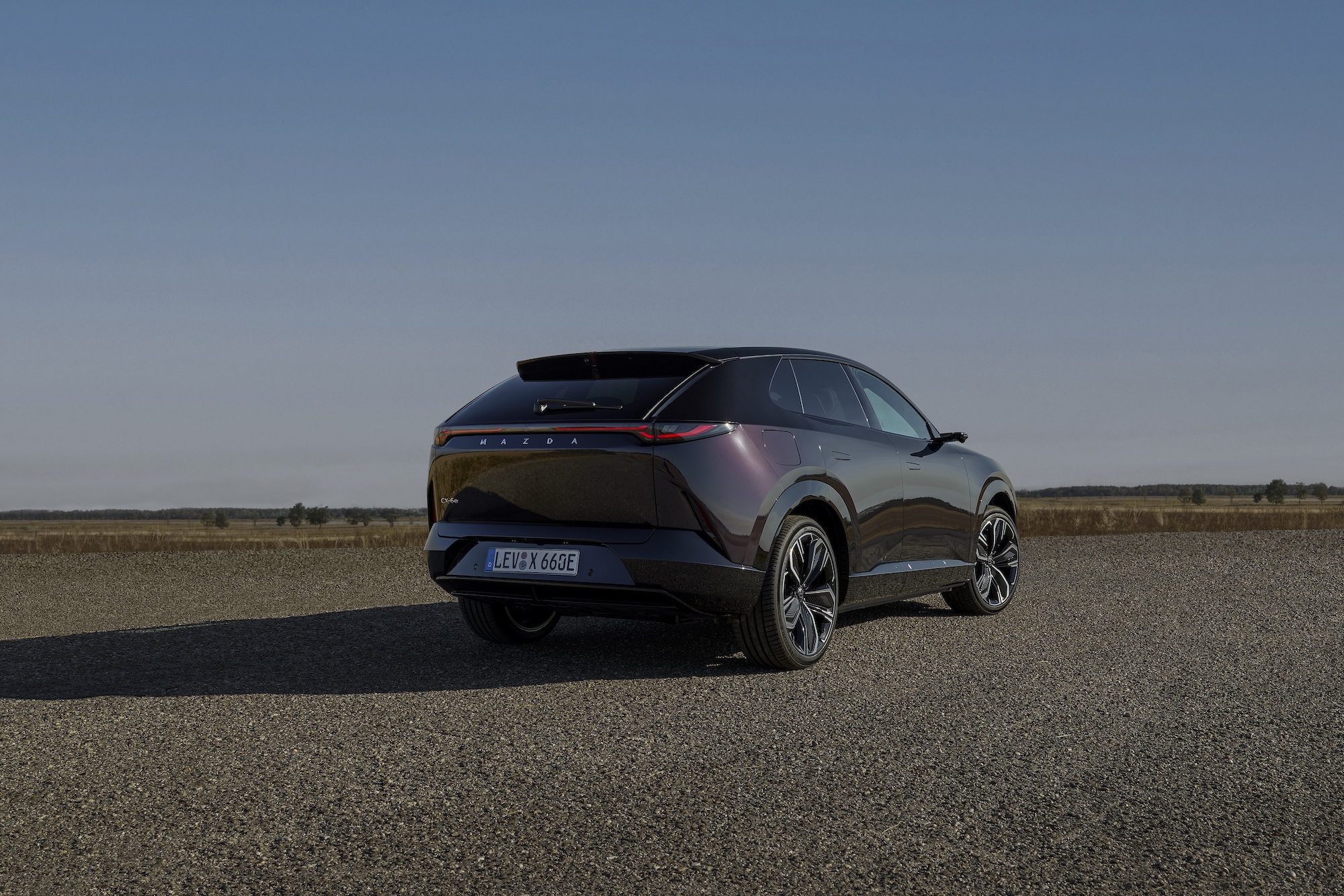
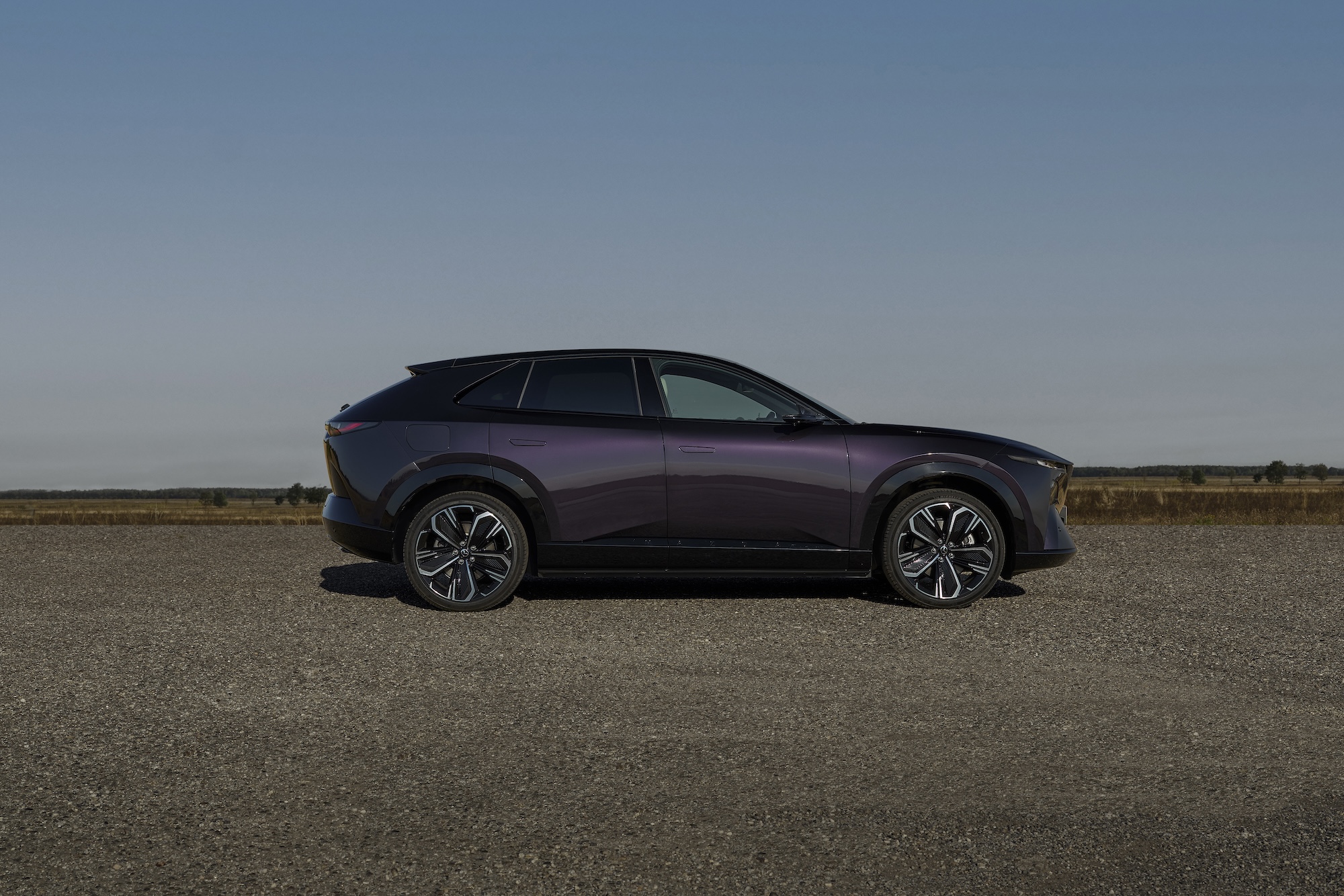



Introduction and model history – Mazda CX-6e
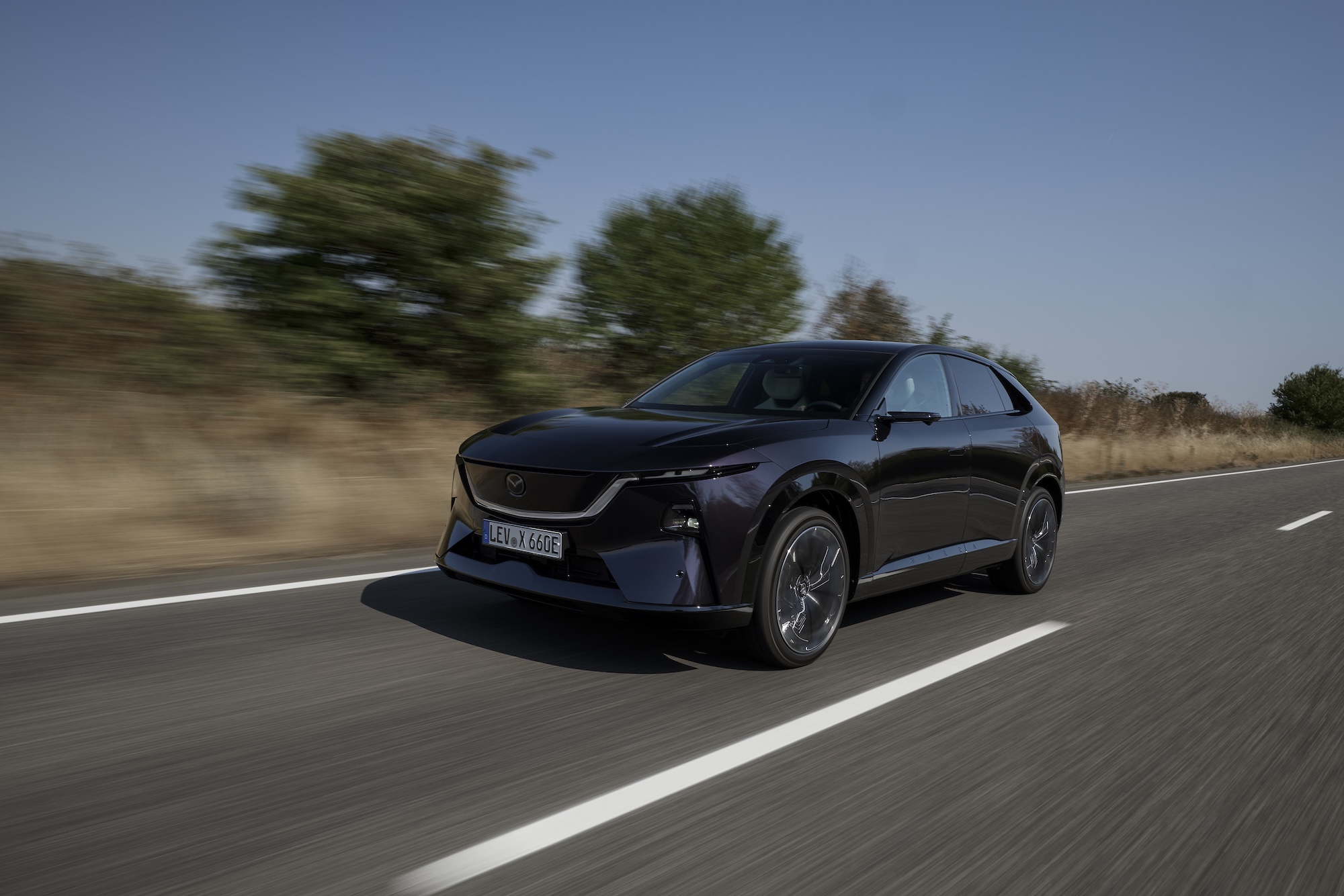
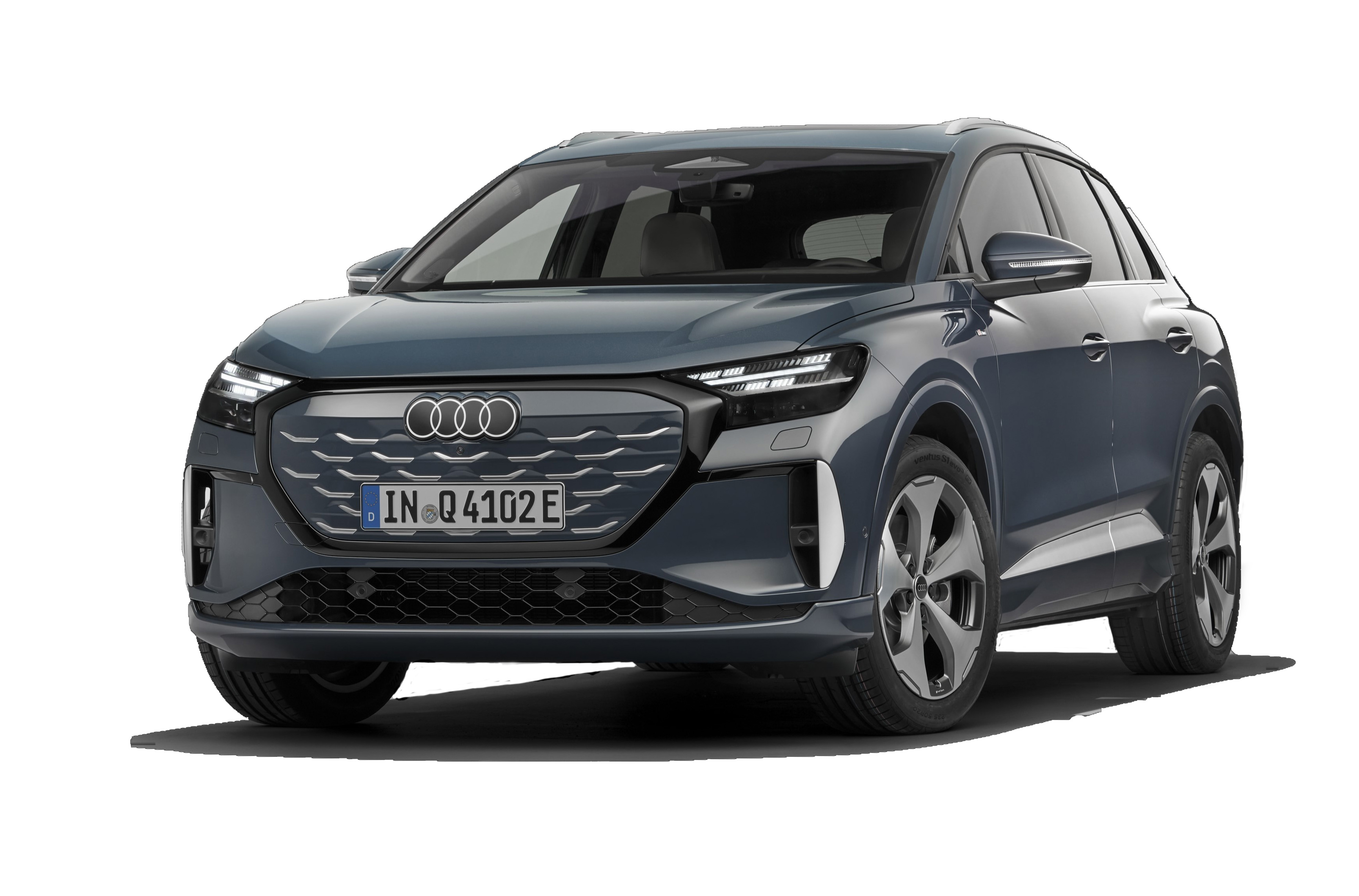
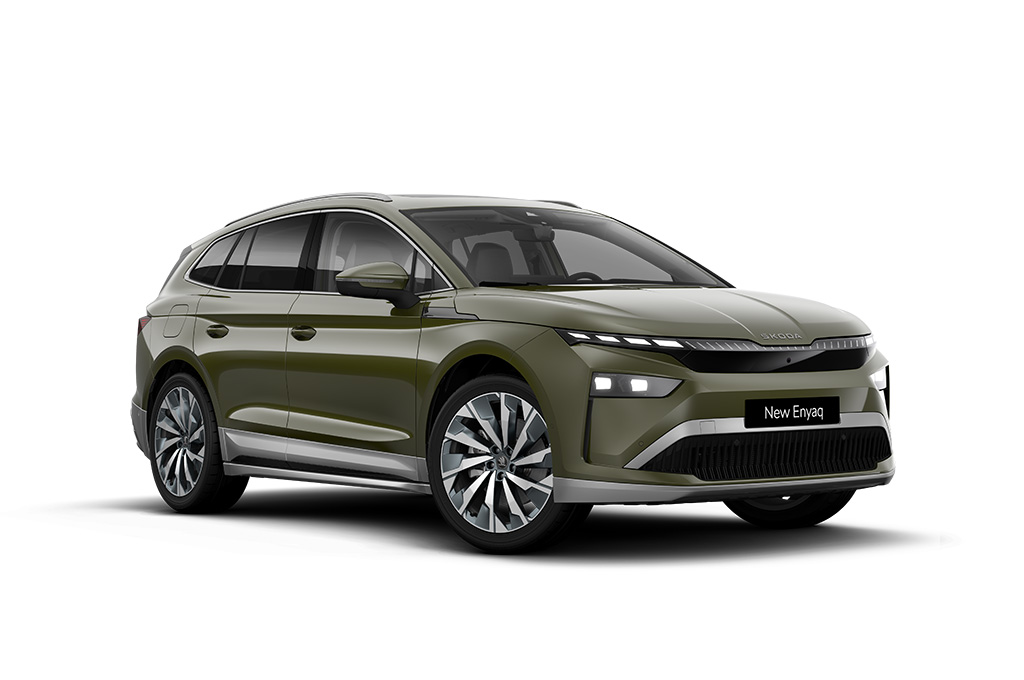
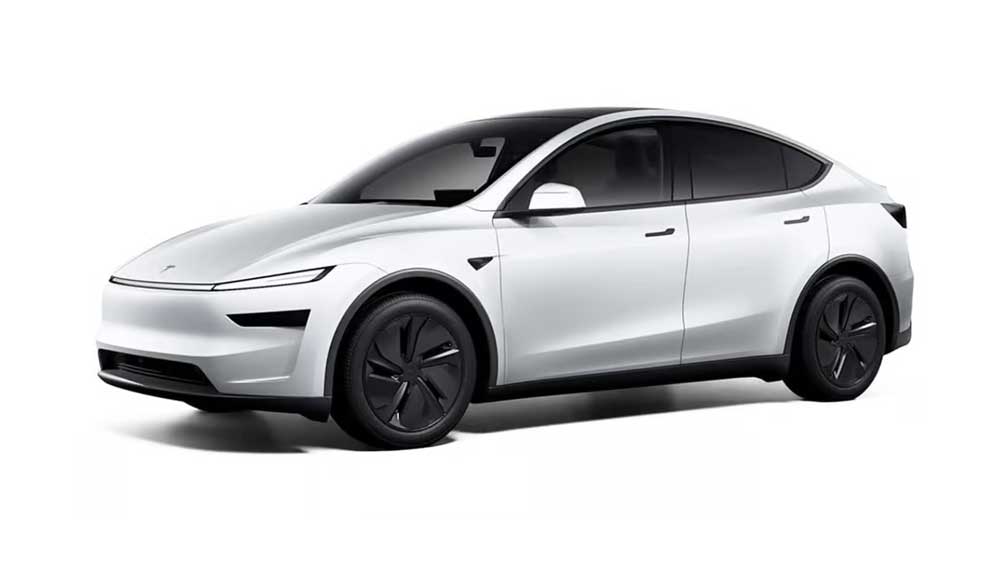
This is the SUV-shaped second child of that Mazda-Changan relationship, and it takes Mazda straight into one of the most brutally competitive parts of the electric-car market. Think Tesla Model Y, Skoda Enyaq, Ford Explorer, Audi Q4 e-tron and a seemingly endless list of Chinese alternatives.
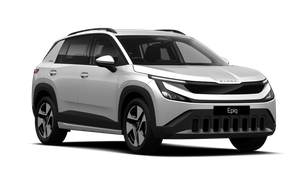
That Changan partnership means the CX-6e shares plenty with the Deepal S07, although you'd struggle to know that from looking at it. Mazda has given the CX-6e its own bodywork and design language, and the result is one of the more distinctive electric SUVs around.
Range, battery and charging
Mazda has made things refreshingly simple here because there's only one battery and one powertrain available in the UK.
Every CX-6e gets a 78kWh useable LFP battery, which gives an official WLTP range of up to 300 miles. That's perfectly respectable, but 300 miles is no longer a headline-grabbing figure in this class. There are rivals that'll comfortably go further, so if your entire car-buying decision revolves around having the biggest possible number next to 'range', this probably isn't the Mazda for you.
Charging is considerably more impressive, though. The CX-6e can accept up to 200kW DC, allowing a 10-80% rapid charge in around 24 minutes on a suitably powerful charger. That's very competitive, and personally I'd prefer to have a car that charges quickly with a slightly smaller range than one that has a massive battery and range but takes for ever to charge.
You also get 11kW AC charging, a heat pump as standard, and Vehicle-to-Load (V2) that provides up to 3.5kW to run external electrical equipment from the car's battery.
My drive of the car in Germany gave an average range of around 3.6 miles per kWh. Not amazing, admittedly, but that did include some fast drives on Germany's famous derestricted autobahns. Also, I was stopping a lot to film the car – speaking of which, you can watch my full review of this car at the top of this review. We'll be testing the car in the UK in the next few months, so we'll report back and give you a more realistic verdict on how efficient it is.
Practicality and boot space
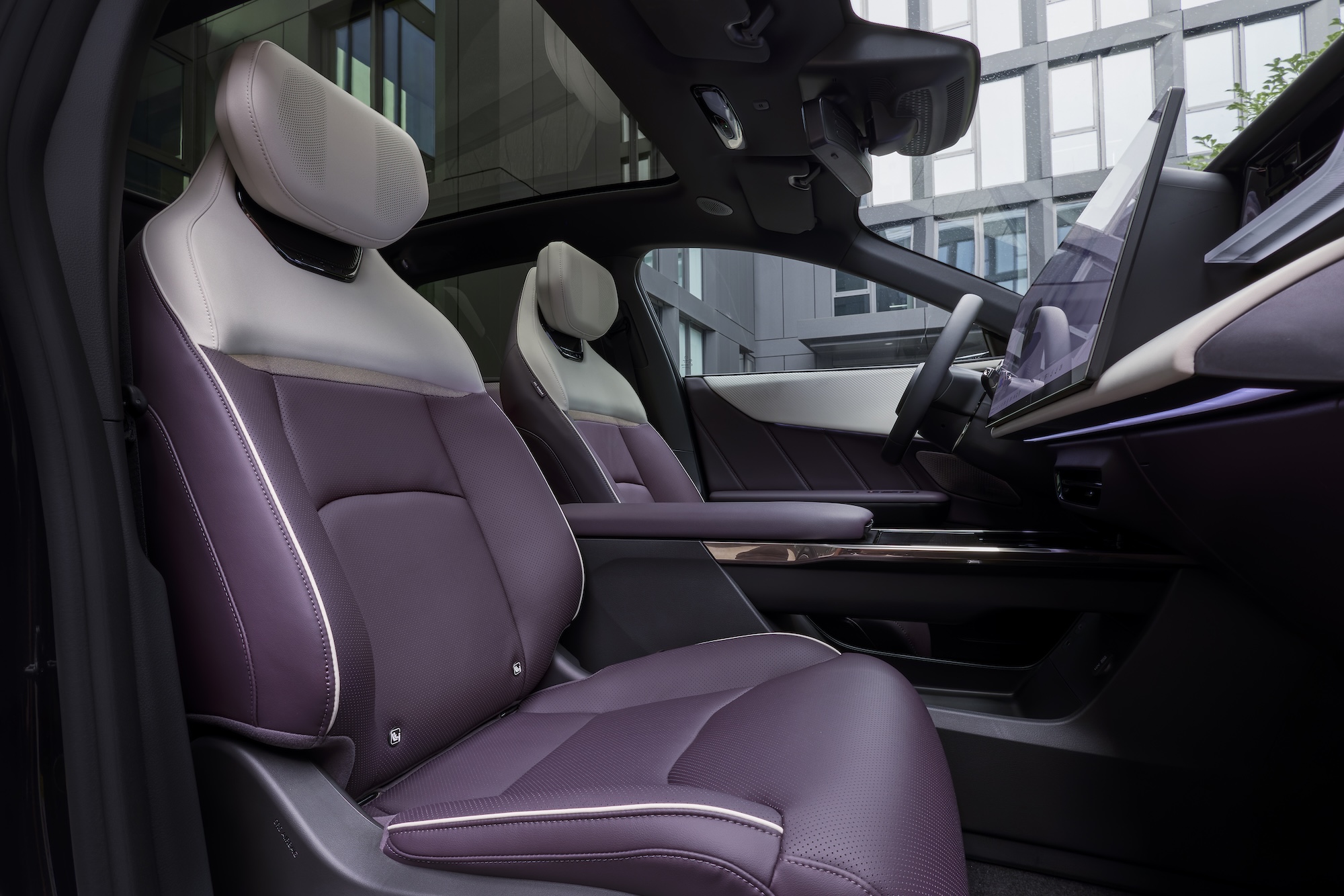
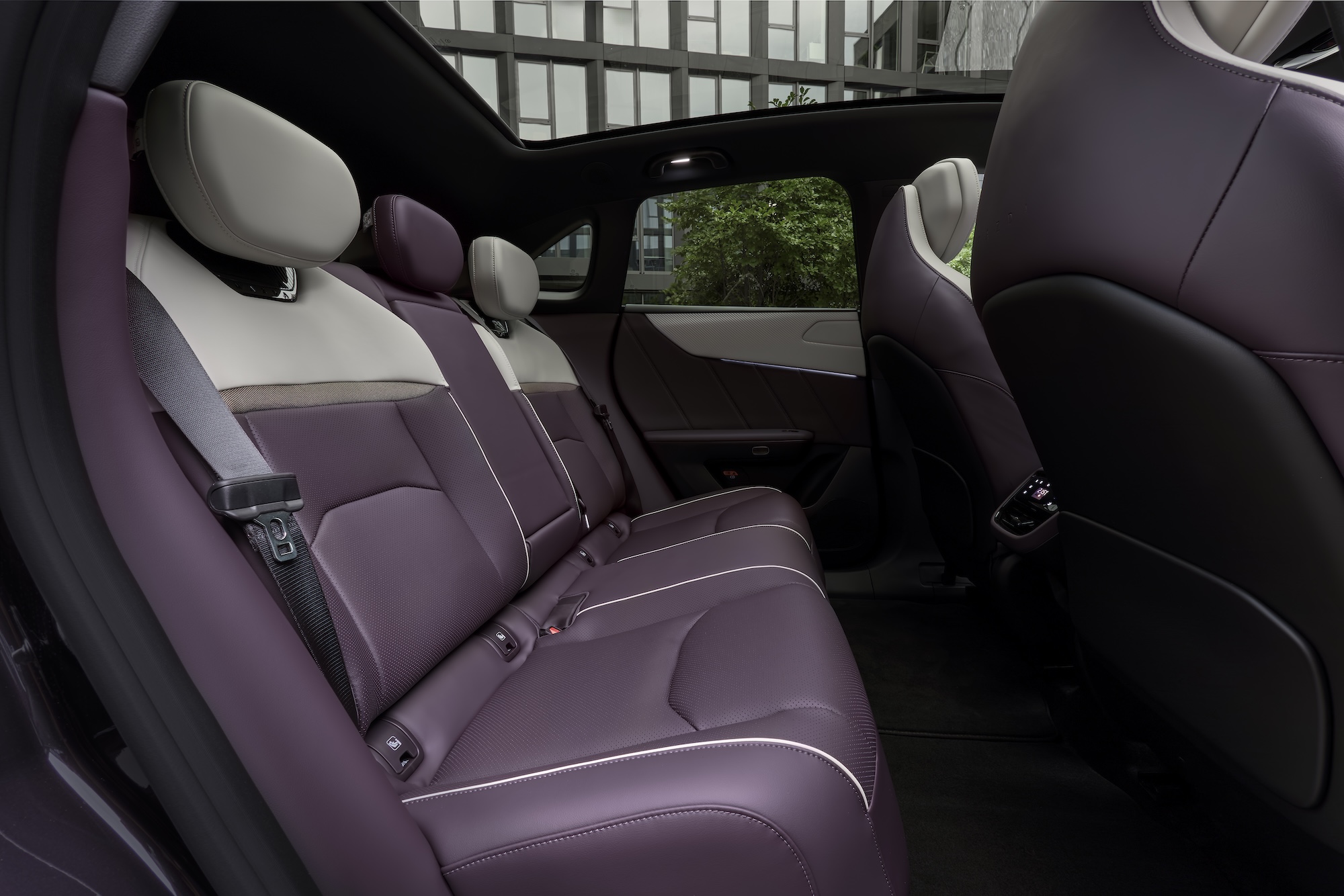
This is one of the CX-6e's strongest areas. Rear-seat space is excellent – it's easily one of the best in this area – and headroom is plentiful, too, despite the standard-fit glass panoramic roof with an electric blind. More importantly, the front seats are mounted high enough that rear passengers can actually slide their feet underneath them, and adults can get properly comfortable. You get ISOFIX mounting points on the outer rear seats plus another on the front passenger seat, while top-spec Takumi Plus cars really spoil rear passengers with both heated and ventilated outer seats.
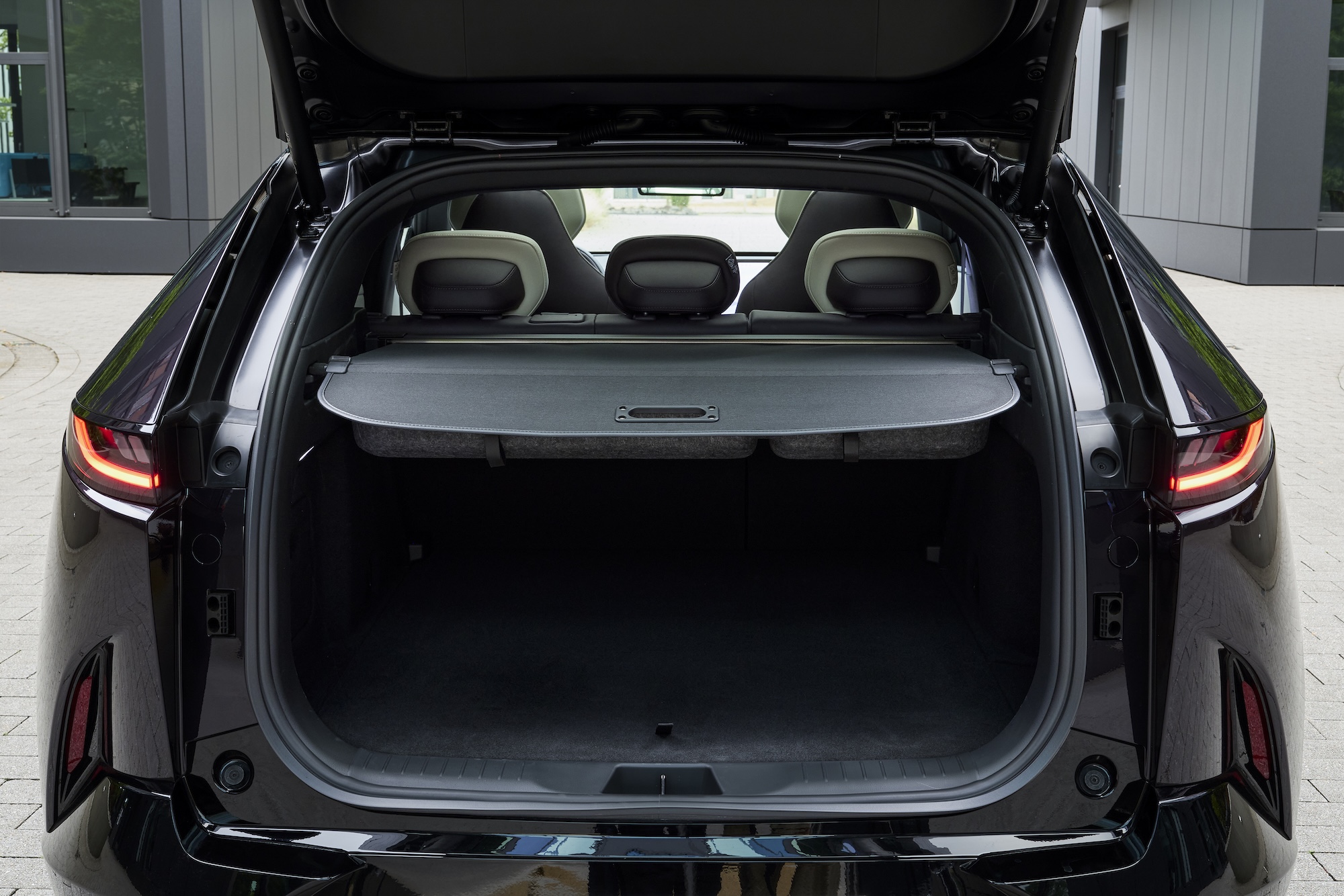
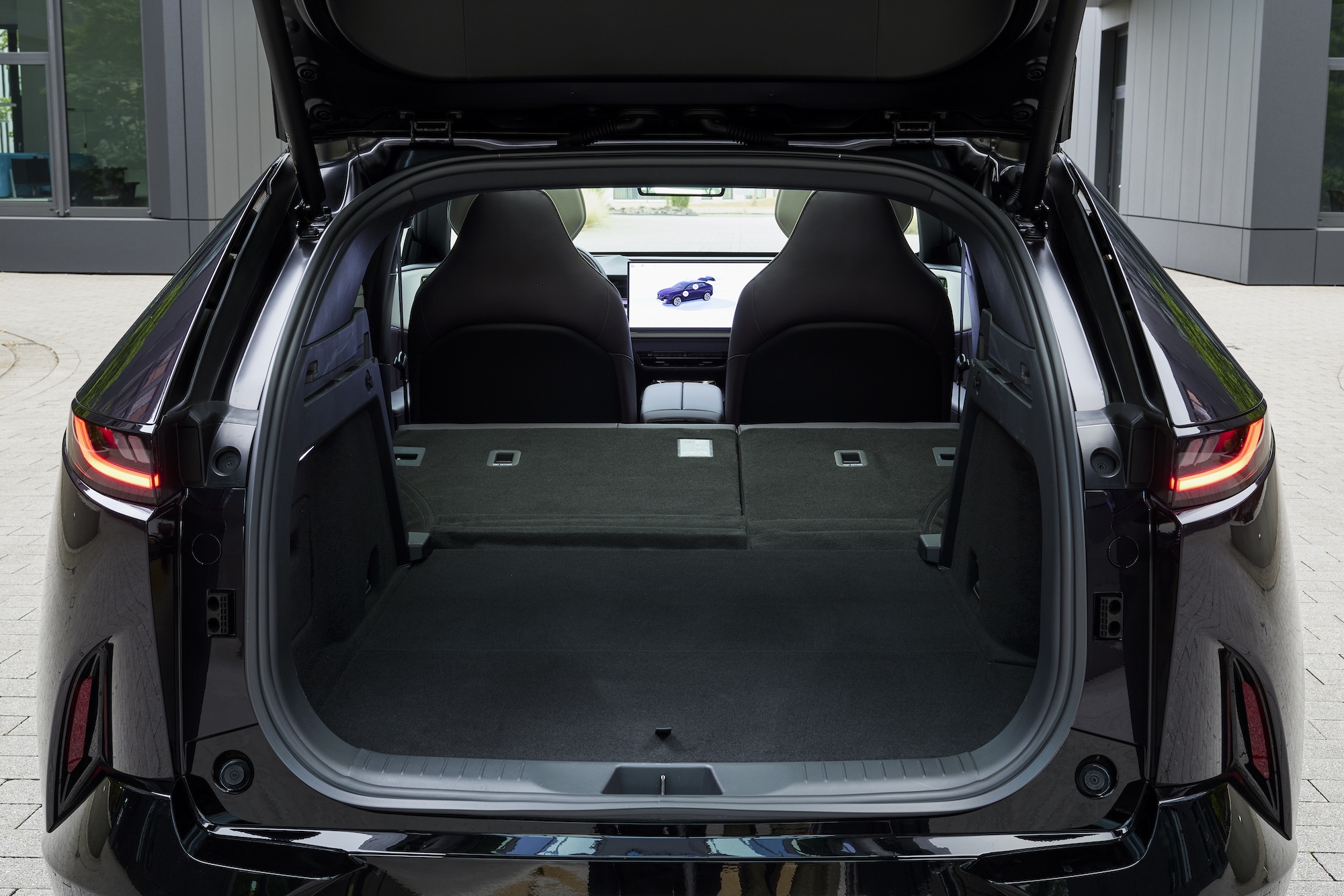
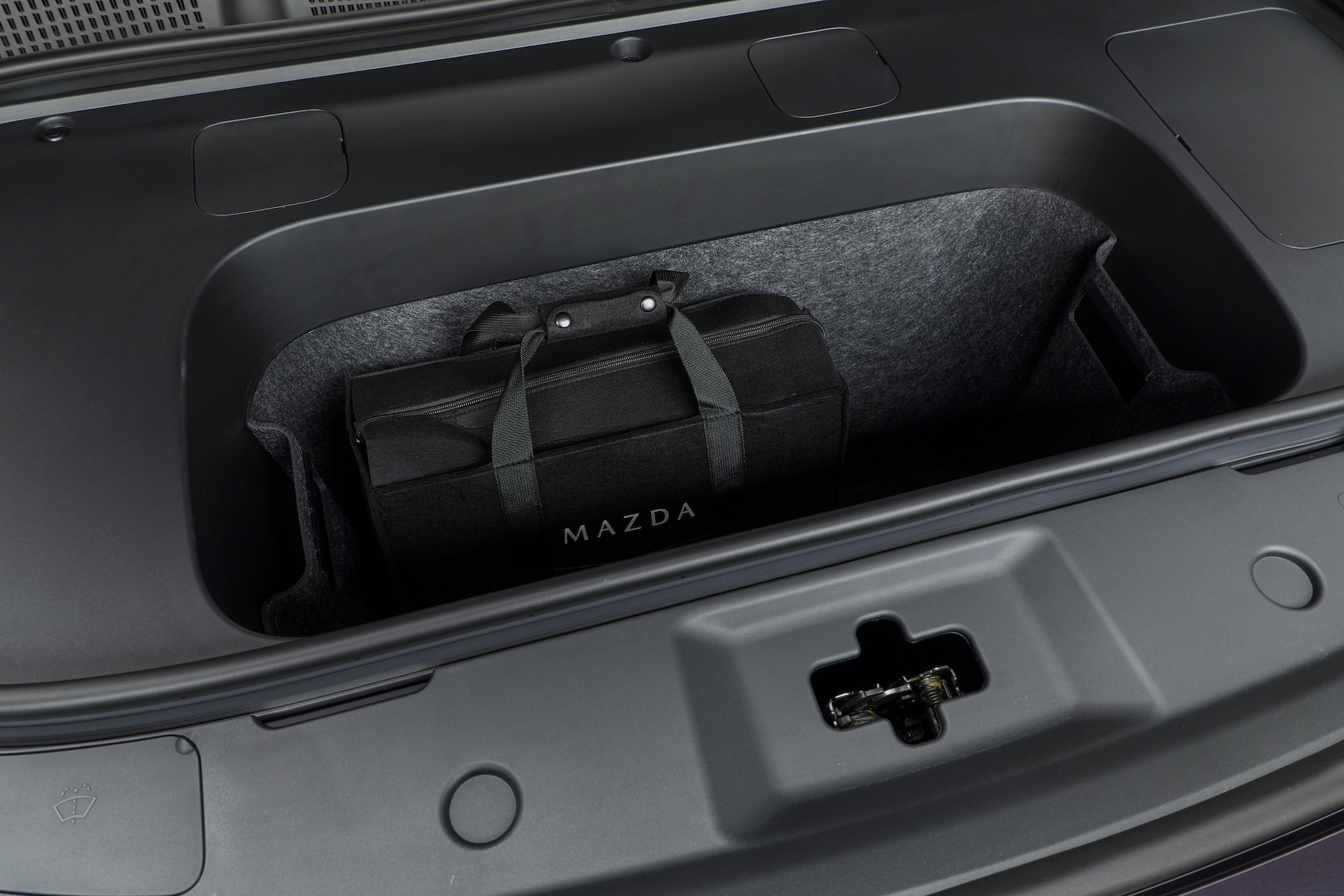
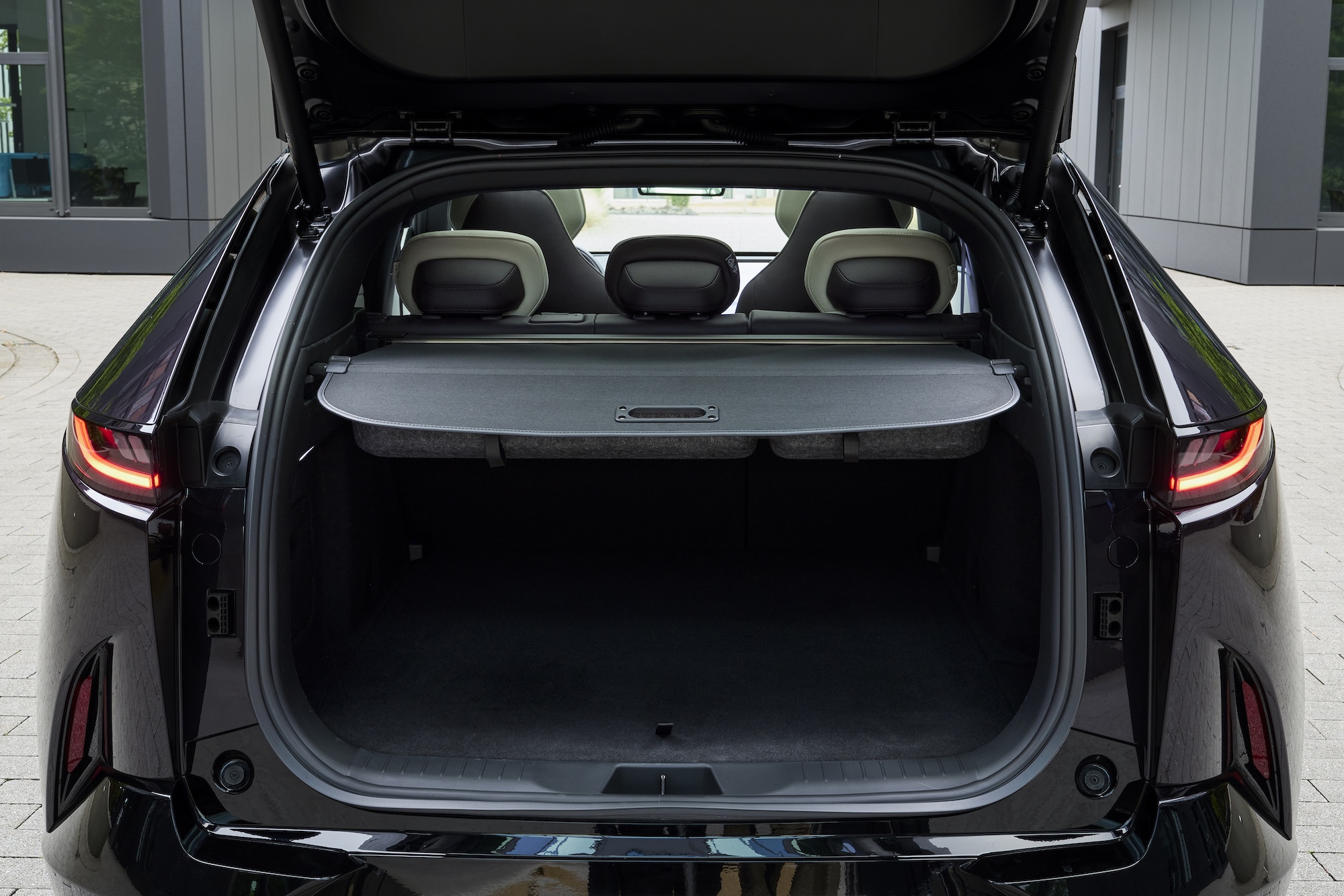
Boot space is fine, but not spectacular. At 468 likes, it's quite a long way behind a Skoda Enyaq's enormous luggage space; fold the 60:40 rear seats and capacity increases to 1,434 litres.Numbers don't tell the whole story, though. The opening is tall, wide and square, making it easy to use, and there are various accessories available to organise the luggage area. Our car even had a felt covered tray that sat underneath the luggage cover, and it was very useful (you can see it in the picture below). This is just one of many practical options that Mazda is offering with the CX-6e.
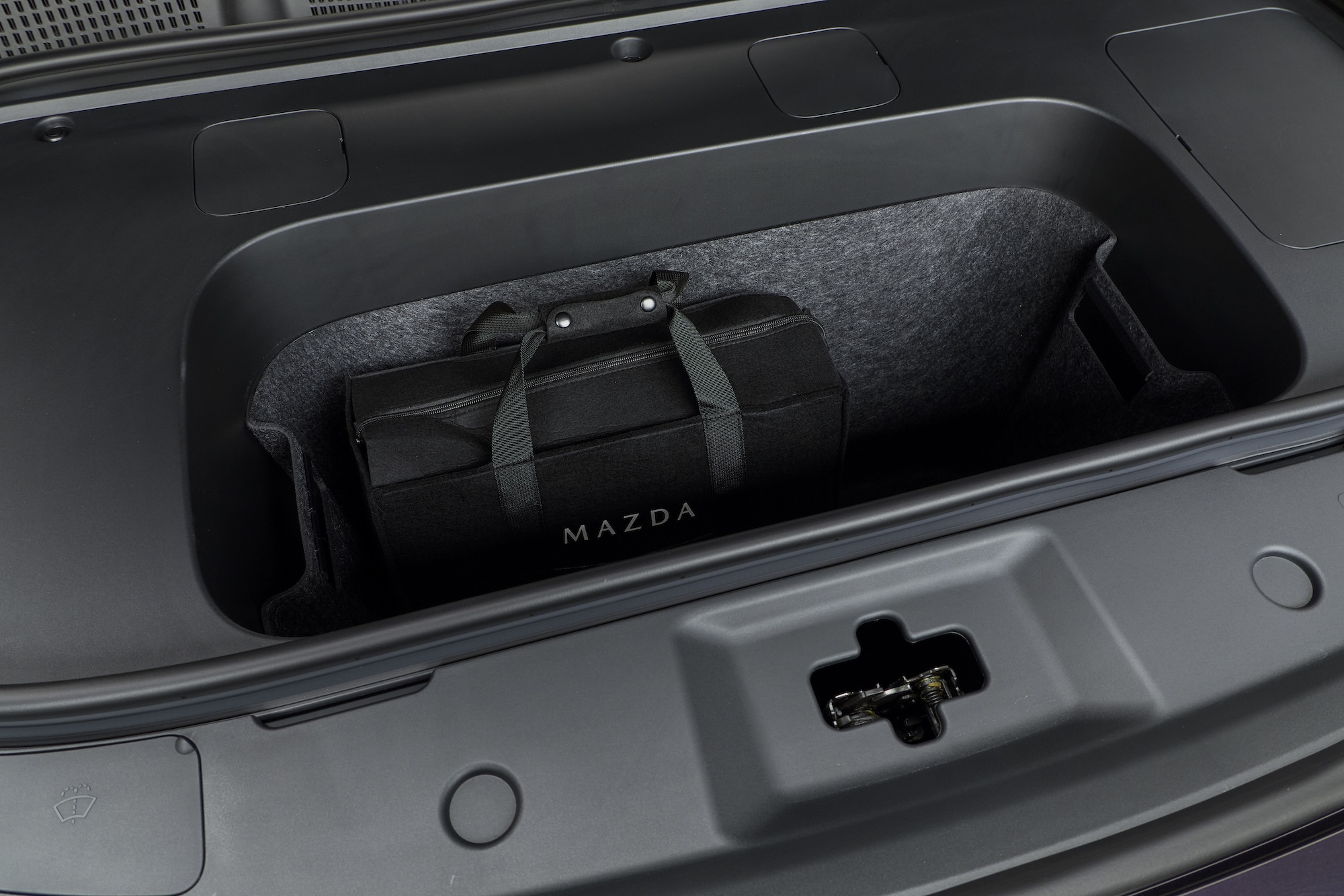
Speaking of options, the CX-6e can also tow up to 1,500kg braked, with an electrically deployable towbar available.While the boot might not be the largest, the CX-6e does go someway to improving things by offering a frunk. At 80 litres, it's actually of a very useable size, and even comes with a removable storage box and charging cable bag.
Interior, design and technology
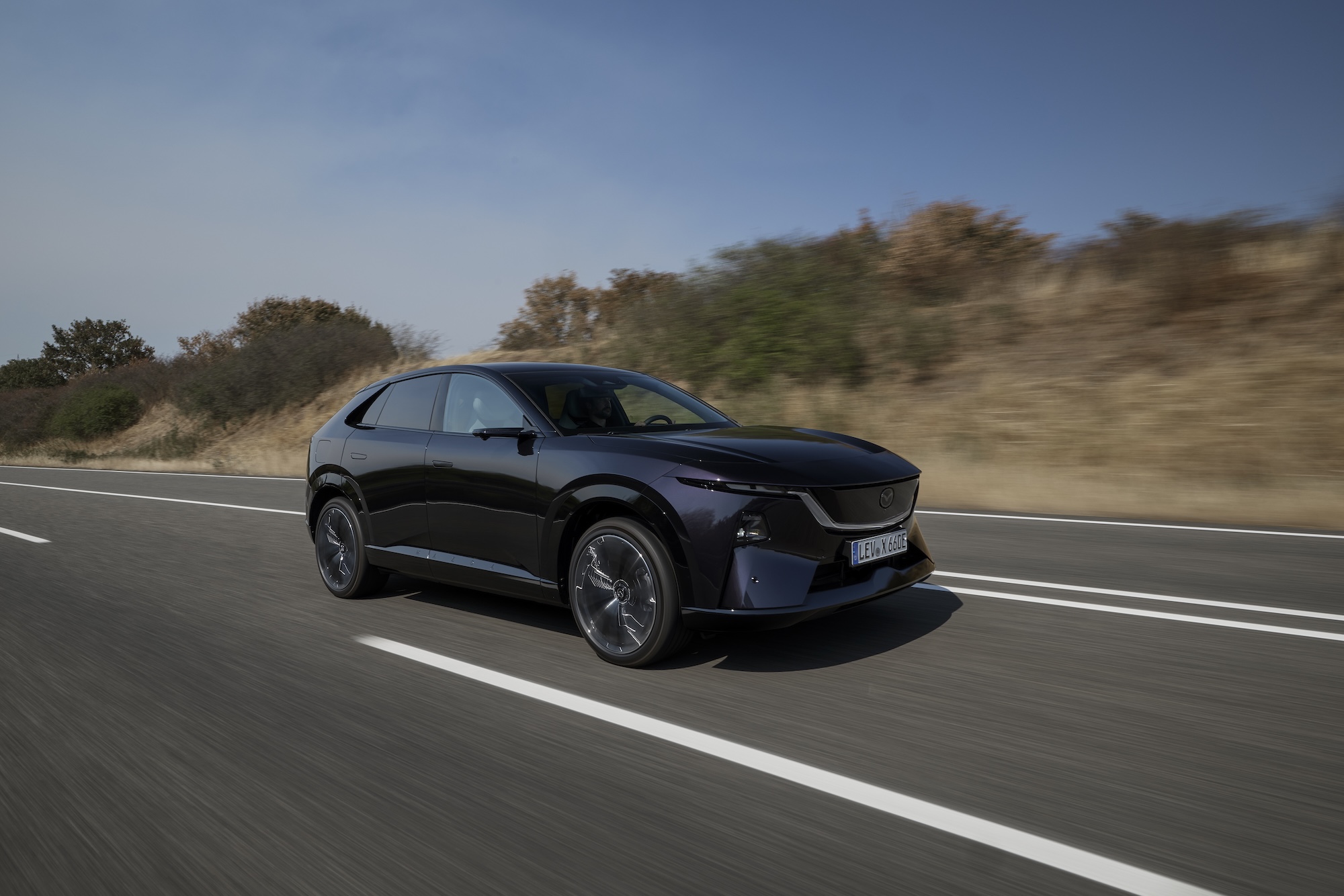
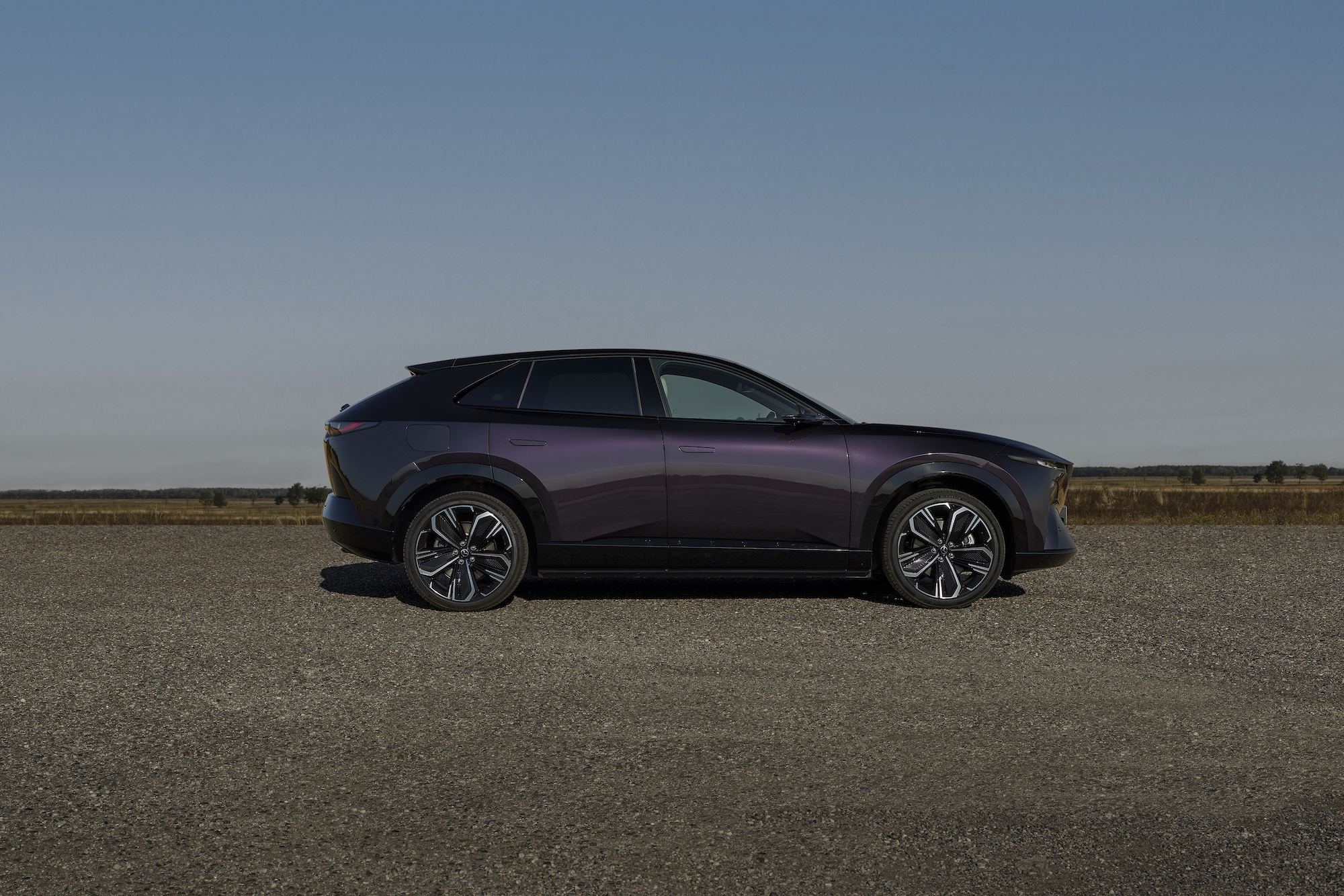
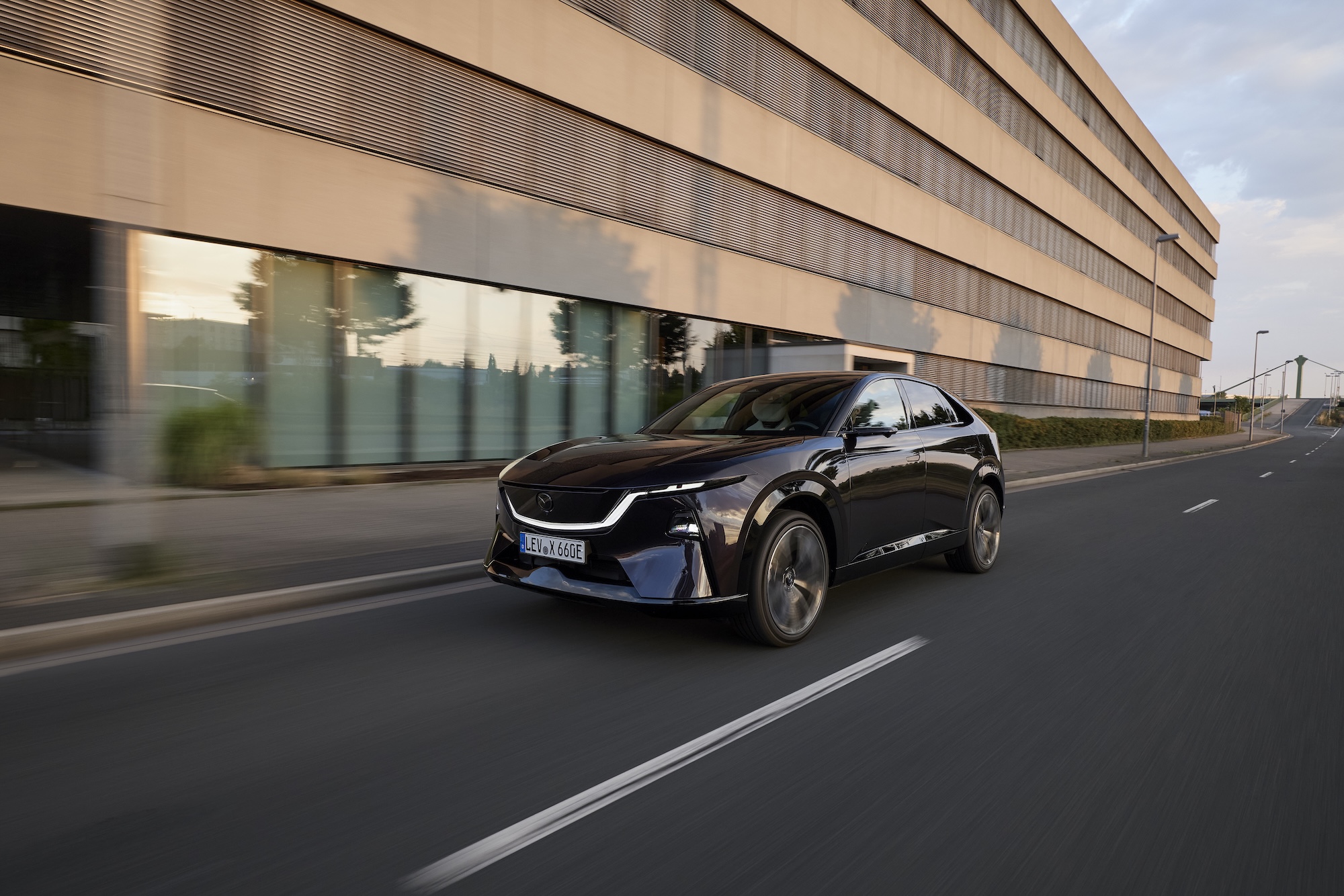
The CX-6e's exterior design is easily one of its strongest attributes, as it manages to look different from all of the other electric SUVs currently on sale.
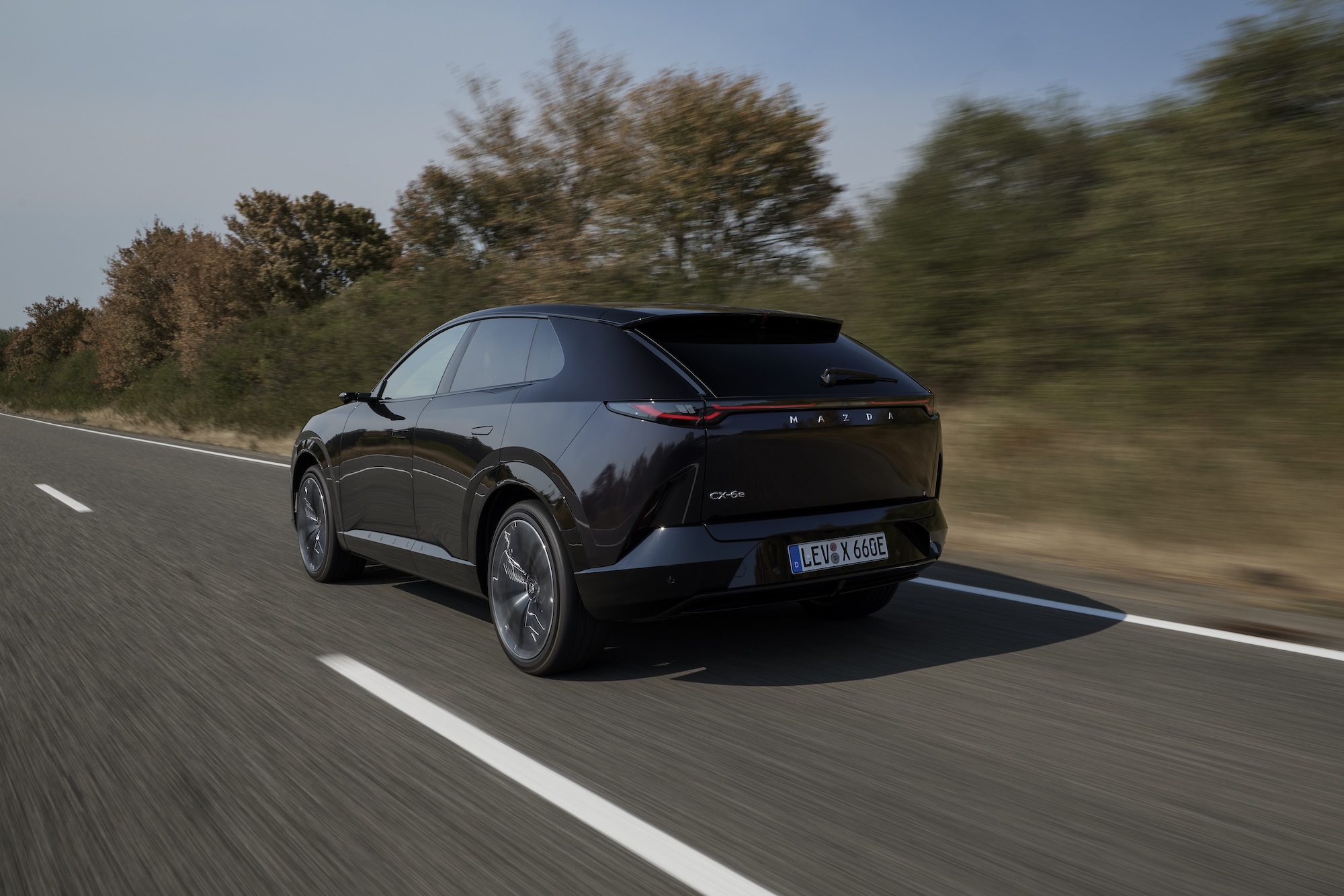
The wedge-shaped profile is immediately distinctive, and the LED lighting front and rear isn't over the top. But there's also some clever aerodynamic trickery going on – a little aerodynamic spoiler on the bonnet helps to direct air over the windscreen, while the rear pillars have channels built into them to clean up the airflow around the back of the car.
For me, the only thing that spoils the very curvaceous and pretty rear-end is the wiper – I'm pleased that this car has such a feature (some don't these days for the sake of better aerodynamics), but surely it could have been integrated into the rear spoiler? Regardless, I think this is a very attractive looking car, and somehow looks like a design concept you'd find on a glitzy motor show stand.
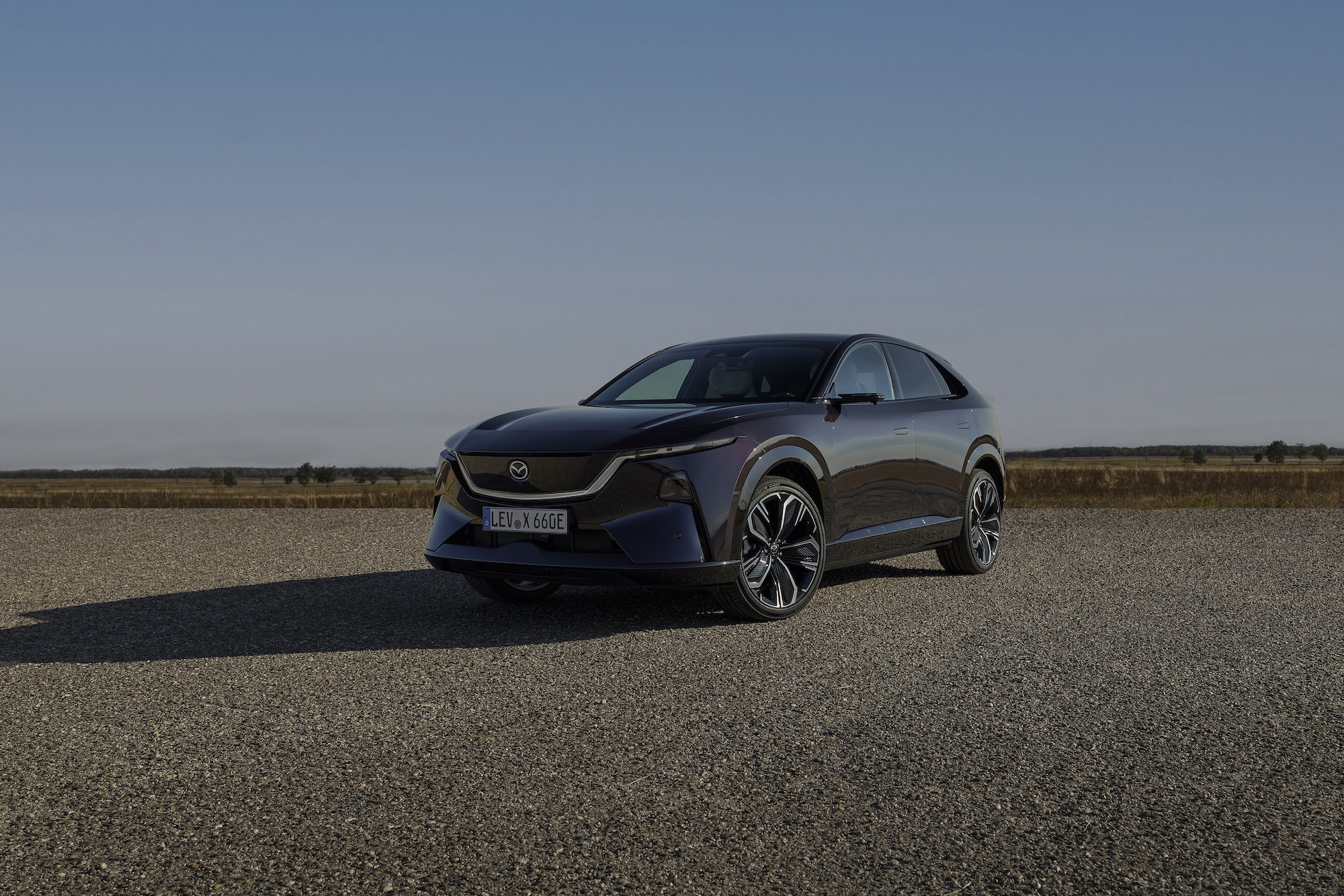
Happily, there's a wide range of bold colours, not just the usual greys, blacks and whites that many European SUVs like to favour. Of course, there's Mazda's trademark Soul Red, but on the CX-6e there's a bespoke colour called Nightfall Violet. Most of the time it looks almost black, but put it in direct sunlight and suddenly it transforms into a deep, luscious purple.
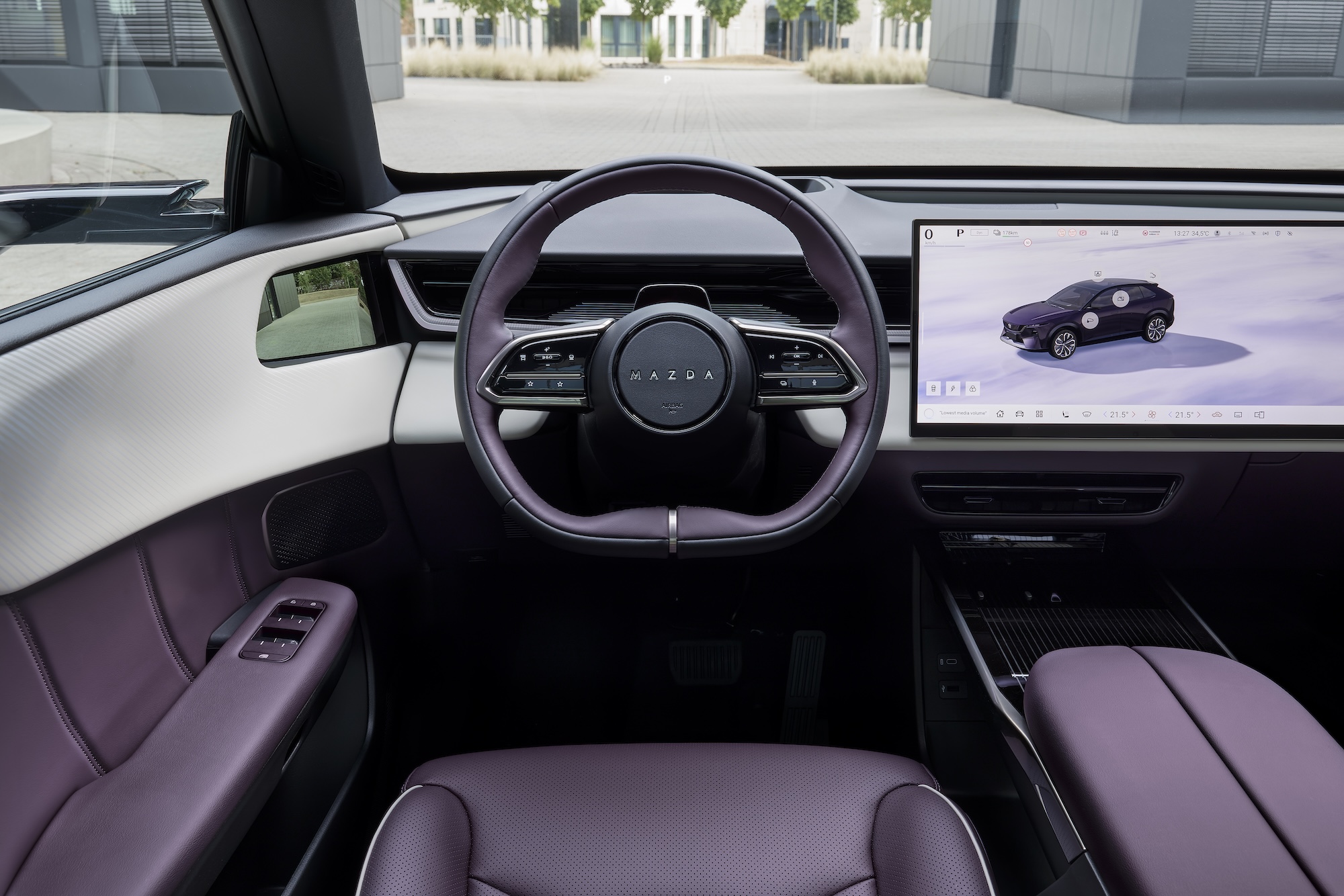
Carrying on with the colour theme, Mazda hasn't held back with the interior shades. While the base-spec Takumi can come with a black theme, there's also a cream-coloured alternative, while the top-spec Takumi Plus comes only with an amethyst and white interior – purple and white, to you and me. It sounds like it shouldn't work, but it really does, and sees purple and white 'Maztex' leatherette covering not just the seats but also most of the surfaces. It looks and feels really premium.
Don't worry, though, the basic Takumi looks and feels just as premium (if not classier, actually), with its mixture of single-coloured Maztex and fabric materials. It also does without the upgraded ambient lighting – which sees a band of illuminated plastic stretch across the dashboard in the Takumi Plus – and instead has a classier (in my mind) strip of silver-coloured plastic.
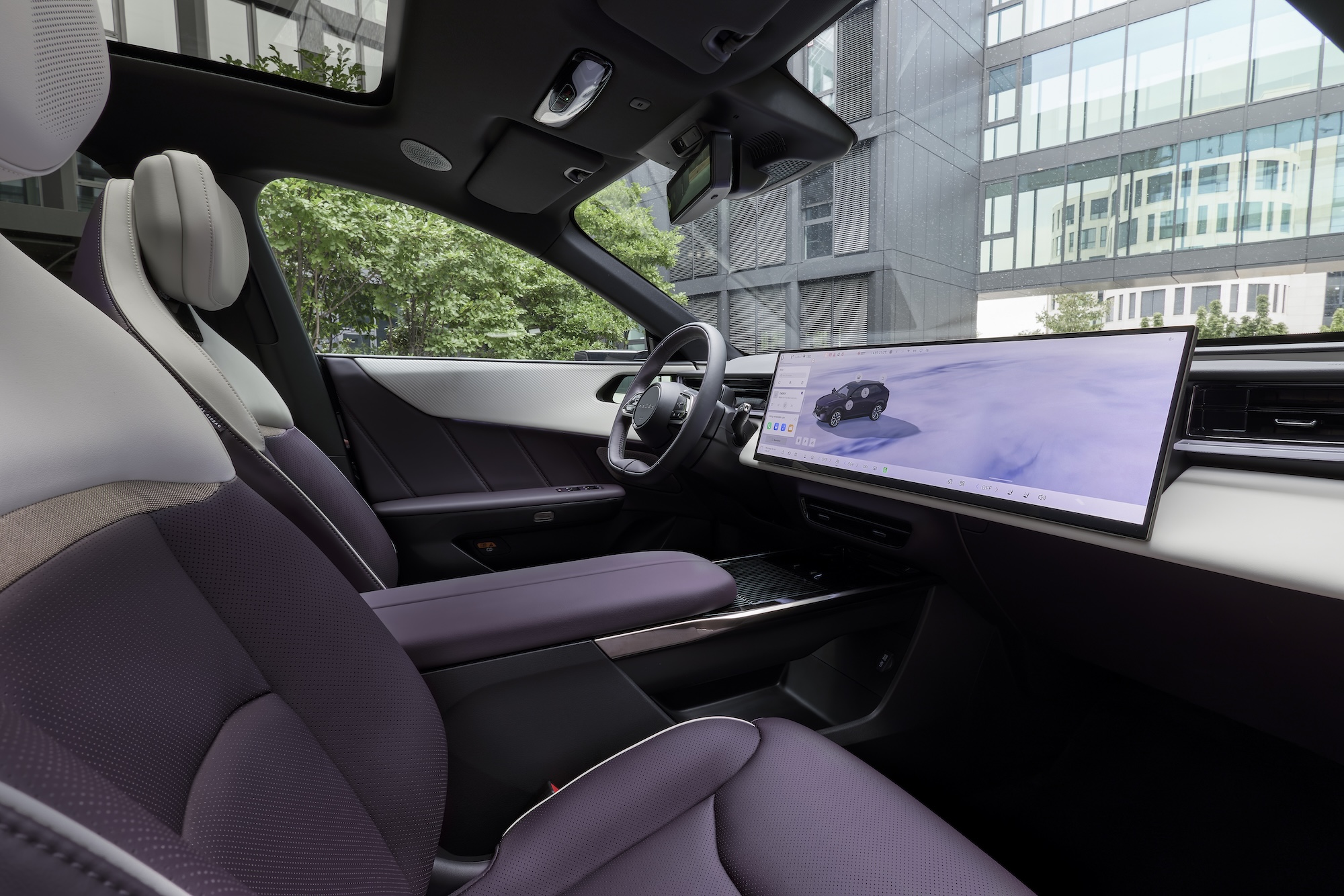
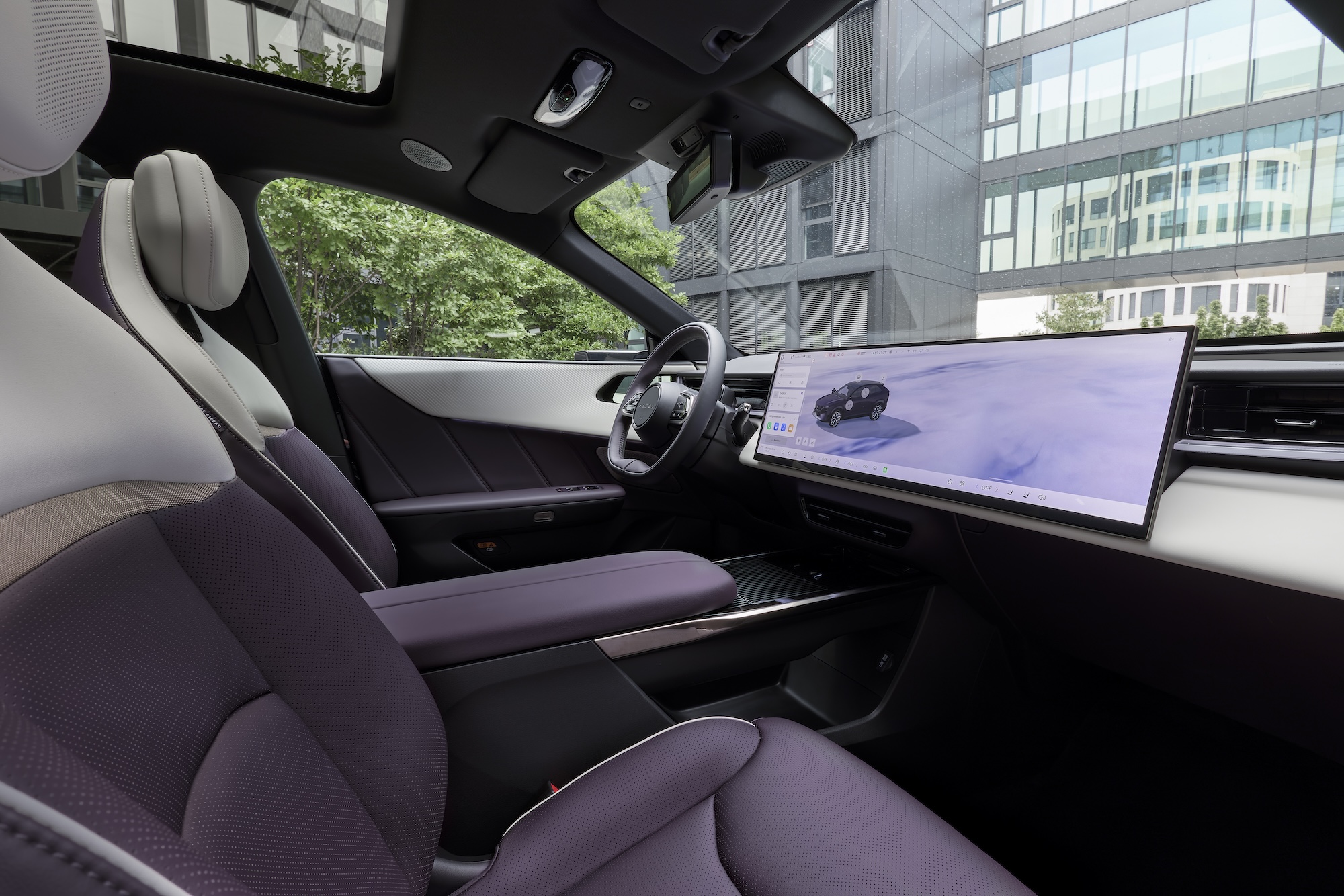
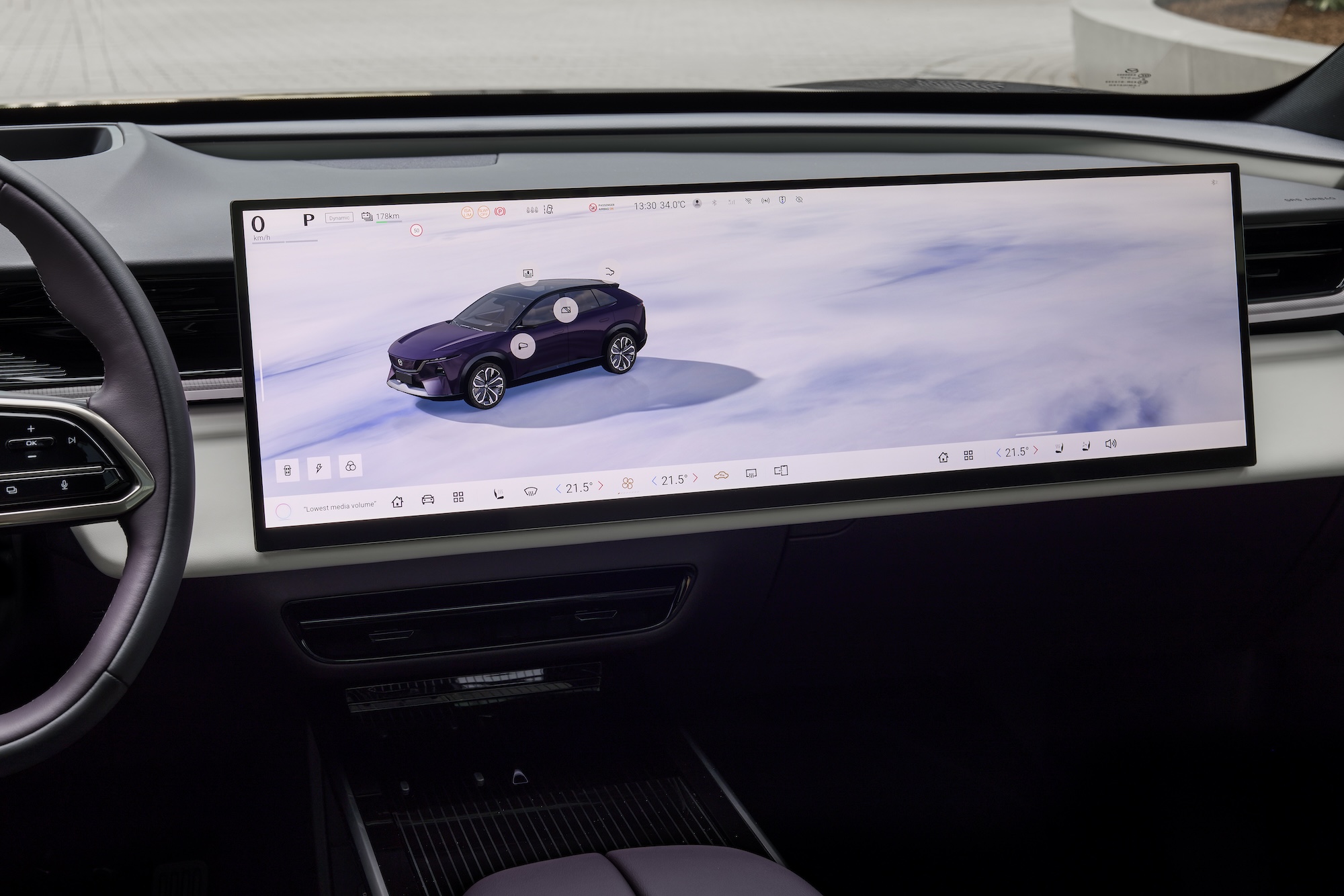
But we're avoiding the elephant in the cabin here – the infotainment system. Measuring 26.45-inch wide, it's enormous. It stretches right across the dashboard, and on the top-spec Takumi Plus, it's bookended by two further screens for the digital door mirrors.
It's especially dominating as there is no conventional screen behind the steering wheel for the driver. Instead, there's an excellent head-up display that's crisp and easy to read. It's very welcome as without it you'd have to glance at the touchscreen for your speed.
The infotainment software has a very Tesla-vibe about it, with similar menus and swipe functions. It works, looks good and responds quickly. There are too many functions to mention here, but some of the quirkiest are different interior modes – such as Rest Mode that adjusts the interior lighting, air conditioning, and audio settings if you fancy a nap – and the external speaker. No, I'm not making this up but there really is an external speaker, which allows you to speak to people outside the car. You can set it to play a series of pre-recorded messages, or write and record your own...
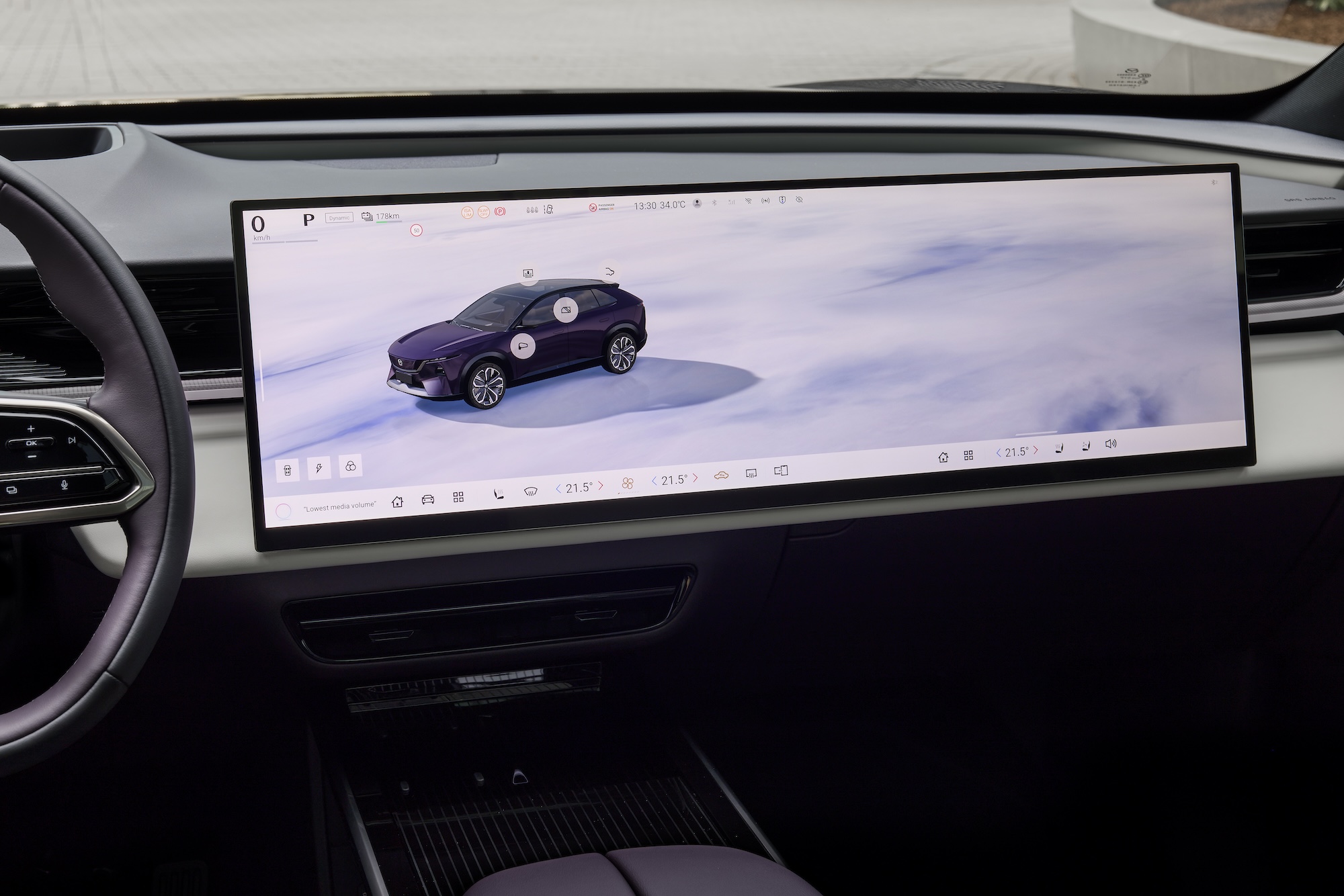
The infotainment system works very well, actually, but the biggest problem is the safety systems. As there are no buttons, everything is therefore controlled by the screen, and if you take your eyes off the road for too long while trying to find a sub-menu or something similar, the car bings, bongs and shouts telling you to pay attention to the road. Also, don't whatever you do and yawn, as the car (rather loudly) tells you to pull over and have a break.
Many cars these days, especially ones from China or one that use Chinese tech, have very touchscreen-heavy interiors and technology that can seem a little overwhelming. But in the CX-6e it's especially jarring as Mazda has long pushed against this trend, instead preferring physical controls and small infotainment screens that are controlled by rotary dials to reduce distractions.
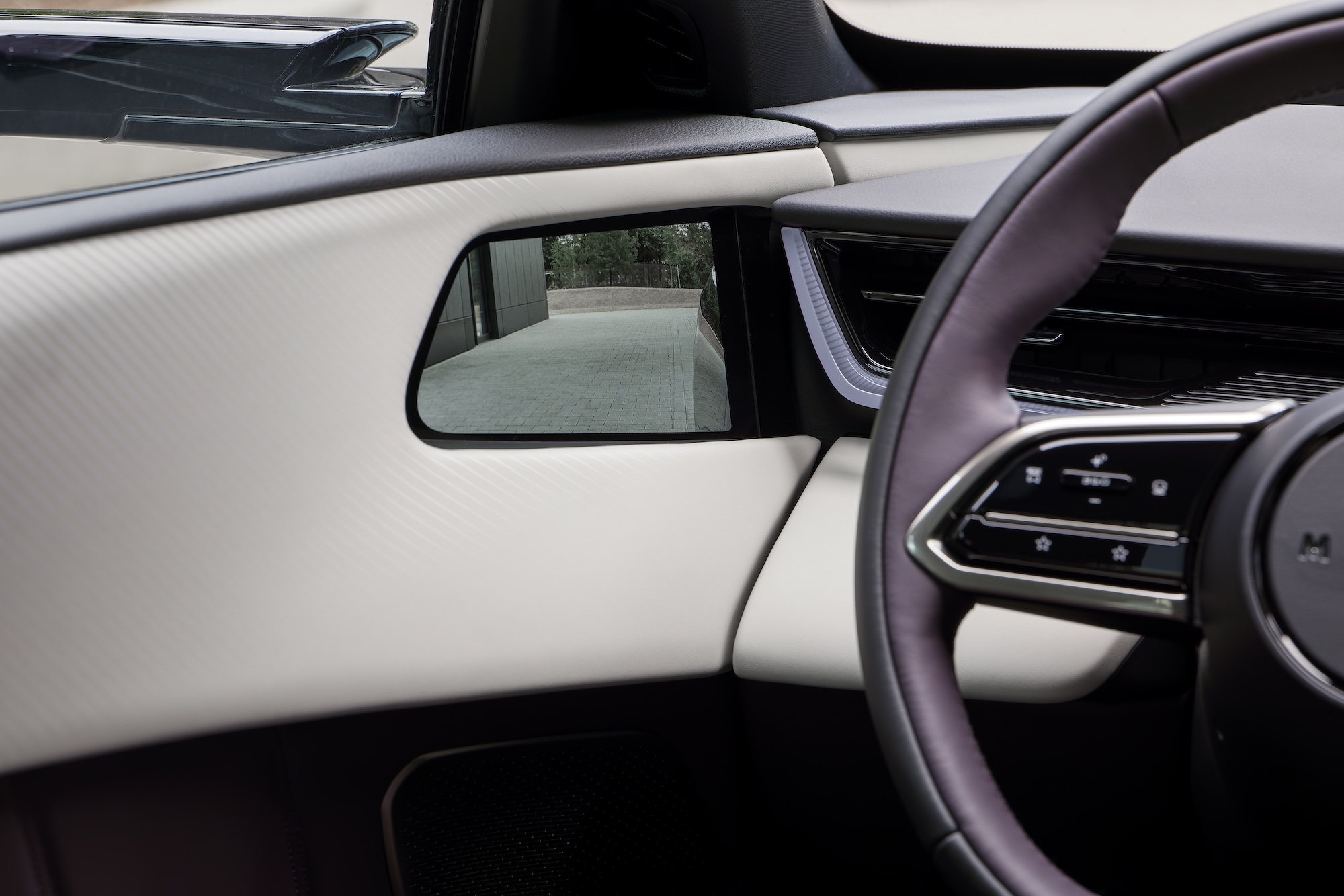
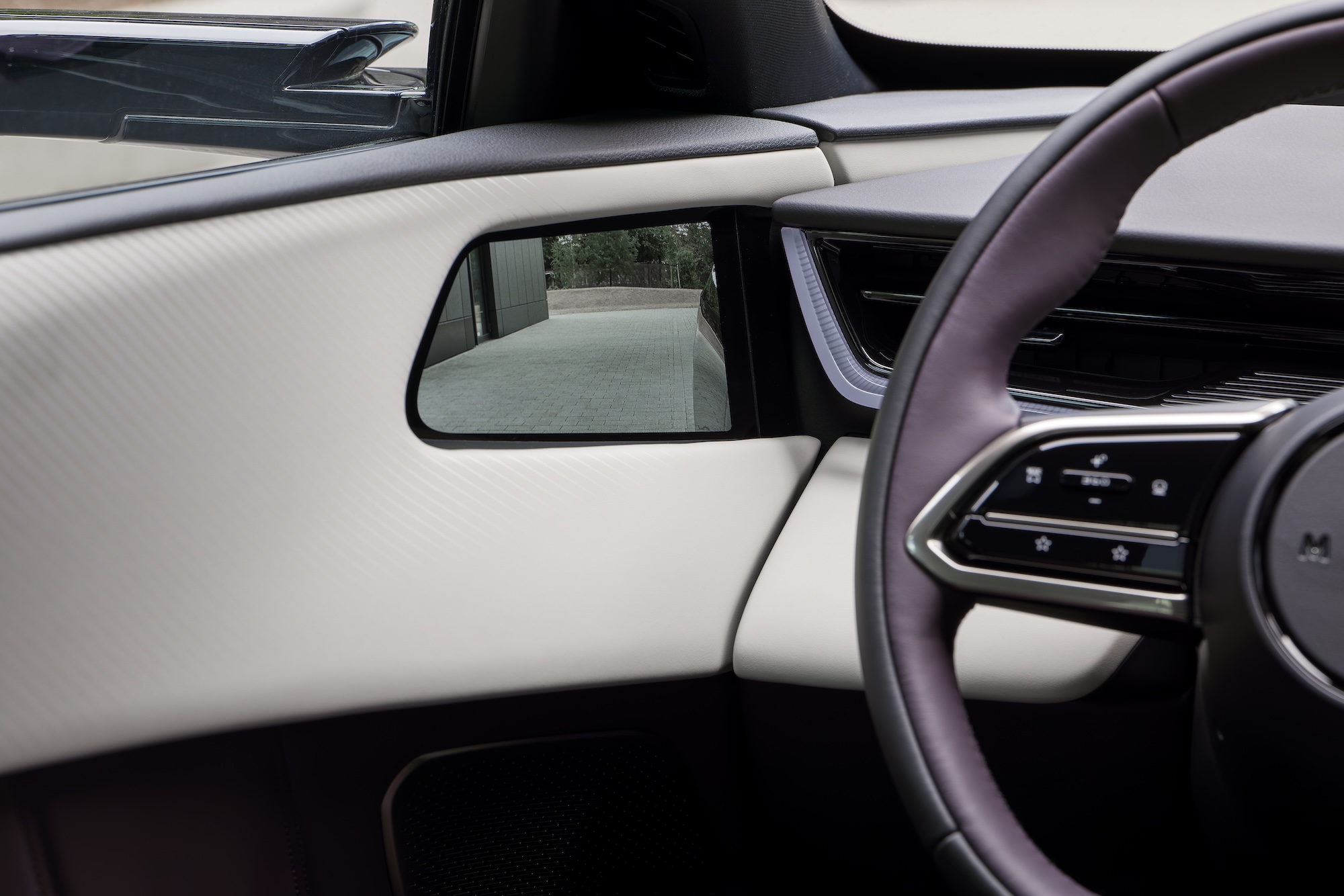
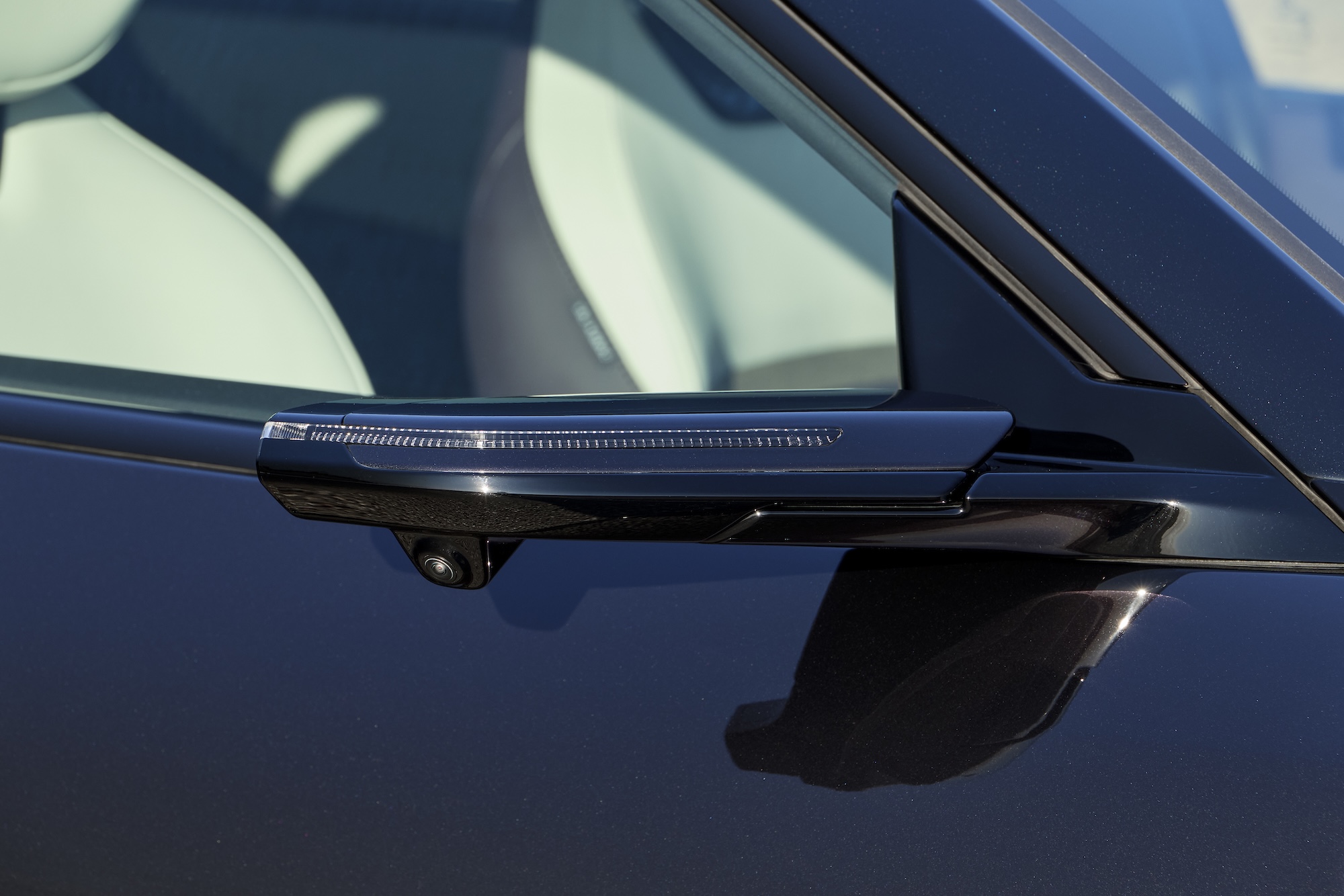
As for the digital door mirrors, the CX-6e's are some of the best we've come across. They're clear and crisp, and with the other noise-cancelling measures like double-thickness glass, do help to keep down wind noise because they're more aerodynamic than traditional door mirrors.
However, with this kind of tech, I always find myself looking at the actual camera, which is where the conventional mirror would be, rather than the screen in the door. It's something you'd get used to I'm sure, but for that last split-second check it's not ideal. Moreover, when driving on German's motorways amongst fast-moving traffic, I found it harder to judge distances with a screen compared to a traditional mirror.
Lastly, along with the digital door mirrors, Takumi Plus spec brings a digital rear-view mirror. The CX-6e's screen isn't as clear and crisp as the one you get in the Polestar 4, for instance, and I found my eyes taking rather too long to focus on it compared to a conventional rear-view mirror. At the touch of a button it switches back to a standard mirror if you prefer, though.
Motors, performance and handling
The CX-6e only comes with a single rear-mounted electric motor producing 258hp and 290Nm of torque. And despite that healthy power figure, the first surprise is that it doesn't actually feel particularly quick.
That's not a criticism as the acceleration is nice and progressive – you don't get the slightly ridiculous EV neck-snap every time your right foot moves half an inch. It feels natural and for a family SUV that's arguably far more useful.
Rear-wheel drive means there's no power going through the front wheels, leaving them free to concentrate on steering, and the CX-6e has a pleasantly accurate and intuitive feel.
It doesn't feel cumbersome, either. There's decent body control and enough balance to make a flowing road enjoyable. But this is where the Mazda badge creates a problem.
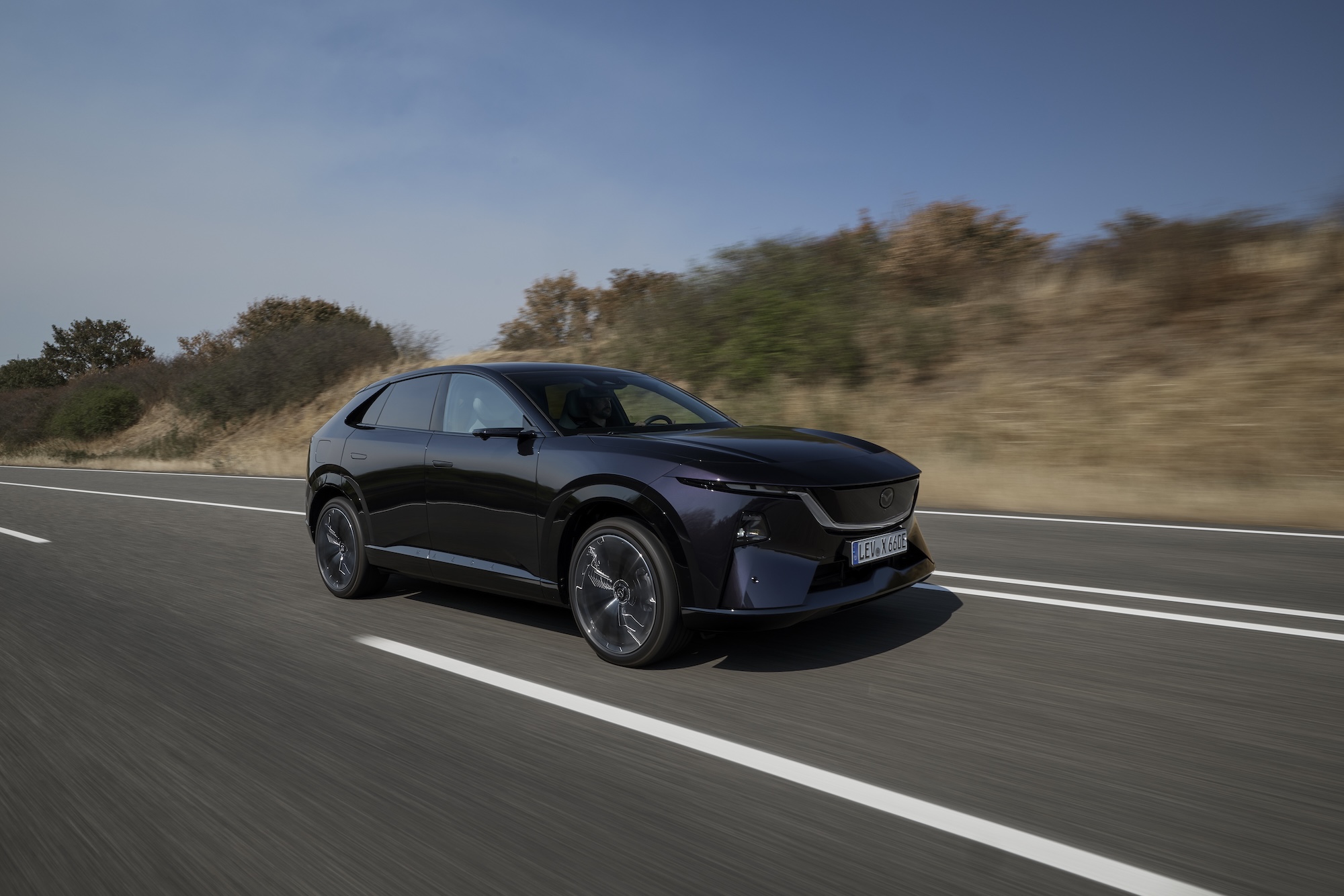
Mazda has spent decades obsessing over how its cars drive. Even fairly ordinary models tend to have beautifully judged steering, body control and that slightly difficult-to-define sense of connection between car and driver.
The CX-6e doesn't quite have that. The ride is generally comfortable, but over rougher surfaces it can become busy, especially at lower speeds. The suspension occasionally seems to be dealing with one bump when the next one arrives.
It's by no means not bad, but just isn't the lovely, flowing ride you'd expect from Mazda at its very best.
Brake regeneration is adjustable through four settings, but frustratingly there are no paddles behind the steering wheel to change them quickly. You have to venture into the touchscreen instead, and there's no genuine full one-pedal mode.
Refinement is much more impressive. The CX-6e is seriously quiet at speed. Motor noise is almost non-existent, road noise is well contained and Mazda's aerodynamic work around those rear pillars and digital mirrors helps reduce wind noise. This is a relaxing SUV to cover miles in.
Overall, the CX-6e drives well, and compared with other electric SUVs, there's little to complain about. But if you're getting out of an MX-5 or CX-5 expecting that familiar Mazda dynamic sparkle, you might wonder where some of it has gone.
Running costs and pricing
Prices start at £42,990 for the CX-6e Takumi, with the range-topping Takumi Plus costing £45,350.
And while that's hardly cheap, equipment levels are very high. Even the entry-level Takumi gets 19-inch wheels, that enormous 26.5-inch touchscreen, a head-up display, panoramic glass roof with a sunblind, heated and ventilated front seats, a heated steering wheel, adaptive cruise control, 360-degree parking cameras, an electric tailgate and a heat pump.It also gets conventional door mirrors which, whisper it quietly, might actually make it the version we'd choose.
Takumi Plus adds a set of fabulous 21-inch wheels, digital exterior and rear-view mirrors, additional ambient lighting, plusher two-tone trim, another touchscreen for rear passengers and those rather fabulous heated and ventilated rear seats. It's only another £2,360, so the upgrade doesn't look unreasonable if you want all the toys.
If I were buying one, however, I'd opt for the Takumi with its more muted interior and conventional door mirrors, and spend £1,000 extra on the 21-inch wheels.
Verdict
At this money there are an awful lot of very good electric family SUVs – Tesla Model Y, Skoda Enyaq, Ford Explorer, Audi Q4 e-tron, Kia EV5, to name a few. But the CX-6e does manage to stand out.
There are some things I'm not convinced by. The 300-mile maximum range is decent rather than outstanding, the gigantic touchscreen feels completely at odds with Mazda's traditionally driver-friendly approach, and you can keep the digital door mirrors, thank you very much. It also doesn't drive quite like a Mazda at its best.
And yet, there's something about it. The styling is fantastic. The interior is enormous and genuinely interesting. Refinement is excellent, charging is quick and the amount of standard equipment makes that £42,990 starting price easier to swallow.
It's not the best electric SUV in every measurable category, but it's different. And in an increasingly crowded market, that might be one of its biggest strengths.

 9
9